The skylight has been covered for days and the dim light is different...we had about a foot of snow complicated by several layers of icy drizzle. I shoveled the walks the first few times until the ice coated the bottom layer and made it easier just to walk on the snow. It just kept coming down. Seems like the drizzle last night finished it off but it may continue today.
Got out my cross country skiis and cruised around the neighborhood a bit; the powder was perfect for it on the first day, but it might be too slippery this morning. I may go try again anyway. It's so rare to be able to ski off the back porch, and pretty darned fun. What I really should do is get the snow off the shop roof before it starts to leak but that would be far too dangerous. Every little thing, including my ladder, is covered with a sheet of ice that will remain until it melts.
Eugene is barely moving this morning, everything cancelled and everyone snowed in. I've been so immersed in the time of the pioneers this seems normal, except being able to walk down to the library and store yesterday before it got too bad. You wouldn't walk far in snow in pioneer days, without knowing a forecast, without the kind of snow gear we now have, unless you had to, or unless you got used to it. I know my Mom walked and rode horses to school in snow in Nebraska, many times, even though one of her actual relatives was lost in a blizzard in 1888. You would certainly rely on the weather knowledge of the old folks, who would know what stage of a storm you were in, and what was likely to come. My young relative and his parents apparently were too new to the country to understand that balminess and sunny weather often foretell a productive storm approaching from the south.
So maybe this thaw we are having means more snow. And this, friends of the Market, is why we don't sell in the winter months. The Fairgrounds has been closed up (tried to ski over there, but no) so not the mess of slipping vehicles and joyriders we had in December. Presumably most of them have tried heading up the mountains.
The pioneers would likely have been more worried about what will happen when all of this snow thaws. The rivers and creeks often overflowed and carried away bridges, houses, livestock, and people, who had of course settled down right next to the waterways for transportation and water supply. It took awhile to get used to the patterns of the landscape. The Davises took claims right along the Willamette, between it and the River Road, which was one of the few trails that were well-used then. That and the County Road, which is now 8th St and heads off on Blair to the northwest, which Huddleston settled on. His property went from the County Road to the Amazon canal, so he had transport on one side and water on the other. Ideal piece of land. One wonders if he knew how valuable it would become as the town was settled. Probably that was what he hoped. I don't think he was really a farmer at heart.
F.G. Vaughan was a farmer though. One of the only newspaper mentions I can find of him is that he brought some watermelons to the newspaper office one day in 1880, and one of them weighed 39 pounds. That's some good farming. James Huddleston was famous for his shooting, though. He was a member of the Eugene Sportsmen Club and they had matches with each other and the Creswell club fairly often. He shot a hawk and some ducks in one. You got points for each type of game you killed, from eagles to cougars to swans, and most animals were fair game. He was later interested in a bill passed by the legislature establishing hunting seasons, according to a letter in his file. Hard to say whether he was a conservationist or interested in it because it might restrict his activities.
There were quite a few mentions of Huddleston in the paper. I think we have some class differences in these people I'm studying, and still more to find out about the stories behind their mentions. Samantha Davis Huddleston left her fortune to the WCTU Children's Home in Corvallis, and it amounted to somewhere between $20-70,000. One of the Evans kid contested her will, so there may have been some public embarrassment surrounding her death. I think she was one of the oldest original pioneers in 1927, and I don't know who was helping her at the end, if anyone. Her son died a year before she did, so that must have been a hard year for her.
F.G. Vaughan died the same year as she did. Instead of my original thought that these people did not know each other, because of their political and class differences, I now think they all knew each other, at least nominally. When Huddleston ran the trading post in the early 1850's, everyone in the area would have stopped in there, including the Vaughans, who were out in Coburg then. I think nearly all of the first transactions of my property were between contemporaries who knew each other, and were sometimes connected by family ties.
And why not? Land transfers were mostly handled within families if possible, to keep the wealth close. I think the Vaughans used the gold they brought back from California to buy land, and that was how they got these west-side properties, farms for the sons who couldn't make it on the one section the father claimed. The Vaughans and the Davises took up adjacent claims with their brothers and sons. They also would have followed the population and the resources. The original Vaughan claims were on land that is now being mined for sand and gravel, and they were farmers, so they would have traded up for better farmland. When F.G. started the dairy, he may not have expected the town to grow up around it so quickly. I haven't yet pinned down the years of his dairy farm at 12th and Van Buren, but by the time my piece was purchased, in 1908, it was probably looking like farming was over in this part of town. Even though streets weren't paved here, it must have been apparent that streets would be coming soon as people flocked to Eugene City to make money. Between 1900 and 1910 the population tripled.
I think both Floyd's dairy farm and Henry Huddleston's bike shop (around 1902) were part of this transition period, when the early residents were trying to keep their footing in the rapid growth of the town, trying to stay alive surrounded by later opportunists, keen to catch some of the riches divided up by the earlier opportunists.
But class issues, racism, and carpet-bagging are probably not going to be themes I will be able to explore in my book. Framing things from our perspective isn't really that fair, which is one reason I'm trying to read a lot of newspapers and primary source material from the time. I think the "characters" did evolve over time (they are characters to me, since they have been gone so long) and I think the combination of Samantha, coming from her Quaker parents Benjamin and Catherine, who seemed to be revered, and James, who came from Virginia, seemed to be comfortable with wealth, and was probably an early racist, is intriguing. I'm fascinated with the items that survived from their lives, each one with some reason for being saved from the scrap pile. Now I wonder if her nephew Evans could have been the person who saved and donated the items. More research!
I didn't get the grant I applied for, which is okay, since I am not that close to publication and it wasn't a polished application with solid theories yet. I am enjoying the research so much I don't care about the eventual publication of it. I stumbled on the concepts of my target audience and the relevance of the research to local history. There could be reasons these folks were somewhat forgotten--maybe I am digging up things that shouldn't see that much light. However, I am persistent, and will keep digging. I have begun looking back at my many journals on the building project, and that is some historical research too.
So let it snow. I have plenty to keep me occupied until I can get back over to the UO to look at the newspapers that aren't online. Have some great books to read on other subjects, too. The stories in The Moth (from the radio program) and in the book We Are All Completely Beside Ourselves by Karen Joy Fowler are wonderfully compelling. Juggling that great writing with the scrawlings of the diaries from the Meek cutoff wagon train and the letters in the Huddleston file makes me glad I live in a time of excellent writing. I think I would have made a terrible Victorian.
However, I think I would have made a fantastic pioneer. I probably would have been one of those who dressed as a man and kept my secret until they went to bury me. Call me Dan.
Saturday, February 8, 2014

Tuesday, January 28, 2014
Imagining Myself as a Pioneer
Finally got some rain again, and of course today was the day I had set aside for errands, so I had to suit up and do them in the wet, but that wasn't so bad. Have to remember not to let my pant legs hang out below the rain pants...but thank goodness for rain gear. Those pioneers just got wet.
I spent the entire last three days cleaning and painting the bathroom. It hadn't really been painted properly when we moved in what must be ten years ago now, or almost. I even did a little sanding, though never enough. It was a year ago when I had to finally put down my cat after a messy illness with which he finally ended up in the bathroom, liking the cool of the tile or the warmth of the water heater, not sure which. I had to clean every surface, and I thought I had cleaned them all, but I'm talking door frames, behind the water heater, all of it. I was happy to do it in service to Jake, whom I miss. Hard to believe a year went by, but they do. Fresh white paint on everything is a treat.
The tile floor is particularly satisfying because I scrubbed the grout with cleanser and thought it would never look clean, but it does. I sealed the tile again just in case. It's like having a new bathroom, and I haven't cluttered it up yet with all of my favorite pictures and things. Small pleasures.
I took a break from my research to do that. Reading the Huddleston stuff in the UO Special Collections was just amazing and I made lots of copies of pages and letters and got a few ideas for further research. It was poignant, thinking what Samantha would have thought worthy of saving, and whether she did it shortly after her husband's death or many years later. She outlived him by over thirty years, even outliving her son at the end.
My writing group gave me some good feedback and suggested that I imagine myself as these women (and men) I'm writing about and get some details like the weather on certain days, and I have been reading a lot of context for the settlement and early town era in Eugene and the frontier in general. It's not too hard to imagine their lives but I think they were tougher and more spare than I can even surmise. The journal books James Huddleston left are filled with transactions for the items he sold in his store, and he probably sold just about everything that was available to sell. His future father-in-law, Benjamin Davis, paid in wheat. They had no money, but wheat grew well here so it was the first crop everyone got in, since you could live on it if you had to. You could even feed your animals boiled wheat if you had no hay. As a storekeeper I had assumed Huddleston was relatively wealthy but I don't think he was immediately.
When the gold started to come back with the miners who left their families here while they went off to strike it rich, he must have taken a fair amount of gold dust in trade, but maybe there was a bank for that. I'll have to do a lot more searching, now that I found these lively, amazing details. There was a letter from Catherine Davis to her children, in her own hand. That was thrilling. I can't quite figure out what Samantha's handwriting looks like, but now I know her husband's and her mother's, so I might be able to separate hers out too. Her son Henry has a few items in the files, seemingly from his childhood, which makes me think she put the collection together rather than Henry. He had used some of the space in the journal books (which were tiny, about 4x6 and smaller) to practice writing signatures, his and his father's I think.
The most compelling item is a page from Jim Huddleston's diary, one which notes Benjamin Davis's death and burial "in the garden." Although the Huddlestons were living on 8th Ave at the time, I think the garden they buried him in was most likely his own, out on River Road where the Davis DLC's were located. He is apparently buried in the Masonic Cemetery now, but was likely moved there when the cemetery was formed. Davis died in 1858, at only 50 years old, and his wife Catherine outlived him for a very long time, too.
I could go on, but I'm hungry. I've fallen in love with the multigrain sourdough from Eugene City Bakery, and I have a fresh loaf just calling my name. Bread and cheese is my go-to comfort food but I'm trying hard to eat vegetables more than bread and nuts more than cheese, and succeeding somewhat. Just the little bit of biking I did today reminds me that I love it and don't even care if it's raining.Riding the stationary bike and looking out the windows is just not as good- I really don't have to make the kind of effort I do outside- I get lazy. I even read while I'm on it. Oh well, scrubbing the floor and painting the ceiling were exercise. Maybe I should start on another room.
Or sit on the exercise ball when I am typing. Too wet to prune any trees today. Saw the bushtits all lined up under the eaves on the clothesline I put up when I had the broken foot, so cute. I know we're not allowed to complain about the rain yet, we have to just enjoy it.
I spent the entire last three days cleaning and painting the bathroom. It hadn't really been painted properly when we moved in what must be ten years ago now, or almost. I even did a little sanding, though never enough. It was a year ago when I had to finally put down my cat after a messy illness with which he finally ended up in the bathroom, liking the cool of the tile or the warmth of the water heater, not sure which. I had to clean every surface, and I thought I had cleaned them all, but I'm talking door frames, behind the water heater, all of it. I was happy to do it in service to Jake, whom I miss. Hard to believe a year went by, but they do. Fresh white paint on everything is a treat.
The tile floor is particularly satisfying because I scrubbed the grout with cleanser and thought it would never look clean, but it does. I sealed the tile again just in case. It's like having a new bathroom, and I haven't cluttered it up yet with all of my favorite pictures and things. Small pleasures.
I took a break from my research to do that. Reading the Huddleston stuff in the UO Special Collections was just amazing and I made lots of copies of pages and letters and got a few ideas for further research. It was poignant, thinking what Samantha would have thought worthy of saving, and whether she did it shortly after her husband's death or many years later. She outlived him by over thirty years, even outliving her son at the end.
My writing group gave me some good feedback and suggested that I imagine myself as these women (and men) I'm writing about and get some details like the weather on certain days, and I have been reading a lot of context for the settlement and early town era in Eugene and the frontier in general. It's not too hard to imagine their lives but I think they were tougher and more spare than I can even surmise. The journal books James Huddleston left are filled with transactions for the items he sold in his store, and he probably sold just about everything that was available to sell. His future father-in-law, Benjamin Davis, paid in wheat. They had no money, but wheat grew well here so it was the first crop everyone got in, since you could live on it if you had to. You could even feed your animals boiled wheat if you had no hay. As a storekeeper I had assumed Huddleston was relatively wealthy but I don't think he was immediately.
When the gold started to come back with the miners who left their families here while they went off to strike it rich, he must have taken a fair amount of gold dust in trade, but maybe there was a bank for that. I'll have to do a lot more searching, now that I found these lively, amazing details. There was a letter from Catherine Davis to her children, in her own hand. That was thrilling. I can't quite figure out what Samantha's handwriting looks like, but now I know her husband's and her mother's, so I might be able to separate hers out too. Her son Henry has a few items in the files, seemingly from his childhood, which makes me think she put the collection together rather than Henry. He had used some of the space in the journal books (which were tiny, about 4x6 and smaller) to practice writing signatures, his and his father's I think.
The most compelling item is a page from Jim Huddleston's diary, one which notes Benjamin Davis's death and burial "in the garden." Although the Huddlestons were living on 8th Ave at the time, I think the garden they buried him in was most likely his own, out on River Road where the Davis DLC's were located. He is apparently buried in the Masonic Cemetery now, but was likely moved there when the cemetery was formed. Davis died in 1858, at only 50 years old, and his wife Catherine outlived him for a very long time, too.
I could go on, but I'm hungry. I've fallen in love with the multigrain sourdough from Eugene City Bakery, and I have a fresh loaf just calling my name. Bread and cheese is my go-to comfort food but I'm trying hard to eat vegetables more than bread and nuts more than cheese, and succeeding somewhat. Just the little bit of biking I did today reminds me that I love it and don't even care if it's raining.Riding the stationary bike and looking out the windows is just not as good- I really don't have to make the kind of effort I do outside- I get lazy. I even read while I'm on it. Oh well, scrubbing the floor and painting the ceiling were exercise. Maybe I should start on another room.
Or sit on the exercise ball when I am typing. Too wet to prune any trees today. Saw the bushtits all lined up under the eaves on the clothesline I put up when I had the broken foot, so cute. I know we're not allowed to complain about the rain yet, we have to just enjoy it.
Saturday, January 11, 2014
Saturday, Saturday...
Yes, I was singing the song when I got up. I listened to that hard, gusty rain early this morning fully aware of how lucky I felt that I did not have to drag myself out of bed, suit up, and go down to the Park Blocks for the day. I so love the sensible people who decided we would not sell during the winter months. I know some of the farmers do (starting in February) but weather is tough on people. It definitely puts the lie to the concept of "homeless by choice" in Oregon. That's just the way some people try to make themselves more comfortable about the overwhelming abundance of their lives. It is not a fun adventure to live outside permanently.
 That cute little Yellow-rumped warbler was the first bird I saw this morning on the suet, and I saw the Bewick's Wren yesterday. I love my simple life of watching birds, reading about the pioneers, and looking around online to see what directions I can take my research. Yesterday I was cruising through the online listings for the Special Collections at UO, and I see that they have three folders of James Huddleston's papers!!! This got me so excited there are not enough exclamation points. I will rush over there early next week and see what they have. It may be disappointing (I counsel myself) as they think his wife's name is Jane, and I know better. There may be little trace of Samantha, who interests me much more than her husband, but considering that he died in 1890, these relics will be thrilling no matter the content. Apparently there is a ledger book from his storekeeping (he had the first couple of trading-post stores in Eugene City in the early 1850's) and some letters, presumably hand-written. I want to see Samantha's handwriting. I thought I had her signature but as it turns out, most of the county records were written and signed by the clerks, not the principals in the transactions. Maybe she put some notes on Jim's letters.
I don't know what else I will find there. I spent the day looking through the photos in their digital collection and they are wonderful. John Baugess's collection of the donut shop and tavern that were urban-renewed from next to the Smeede Hotel in the 70's are cool, reminding me how long some of us have known some of the rest of us. There are many photos of important houses during restoration, including the Daniel Christian house which is one of the oldest. I found more evidence of my theories about this place. I didn't even get halfway through the archive. Is it arrogant to think I can add to the research on Eugene's early days?
I applied for a grant from the Historical Society to publish my book, to finish the research and write at least one book of it. I am actually thinking that two might be necessary to avoid the one being too personal and not relevant enough. To quell my self-doubt as I wait a month to hear if I got the grant, I have thrown myself into pinning down details and gathering a lot of background knowledge so I don't say too many stupid things in print. The grant money doesn't really matter so much, it's more the motivation of it, as it is so easy to put the project aside to focus on one of my other projects, of which I have far too many, all a bit too large. I am so passionate about this research, and I know passion fades, so I am trying to really get something on paper and make some tangible progress. I have been filling out the family group sheets for the families I am studying, and it's fun, kind of takes the place of crosswords or sudoku in keeping my brain pliable.
Meanwhile I am getting no physical exercise and have to bring that one higher on the priority list. I couldn't sleep after a day online, started doing that self-recrimination of the late night, which I got out of my brain by thinking about the yellow-rumped and the Bewick's. I love birds, and plants, so that makes things all right in the world. It worked last night, anyway.
So if we get some breaks in the rain today I will get out and look at something, some buildings or some trees. I constantly speculate about what plants Samantha, Miranda, and Grace might have put in this neighborhood. I know Catherine Davis so loved a couple of large firs she insisted they be saved, and I wonder if they could possibly still be there, only 150 years down the road. They were in the River Road area, just off the road, apparently. They'd be huge, so they ought to be visible in the skyline. I could bike out there and try again to pinpoint the boundaries of the Davis land and see. I also have to go to the Creswell cemetery and find Tillie Van Harkin. I realized that she is the person who divided the property into three (or four, depending on where 200 feet from the corner is) so I have to learn more about her. She may get the credit for a lot of the improvements. She lived here (or owned it) for 18 years, until she died in 1942, but she was old, and she certainly didn't do the work herself. It's another effort to check directories and figure out who actually lived in the places, and I want (obsessively) to fully document every year of this place. I want to know exactly where all my people of interest lived, and I even want to know all of the first owners of the Huddleston lots.
I have plenty of directions to keep going, and plenty of ways to distract myself from the main points. The digressions are fascinating. I discovered three of the Vaughan brothers had married women with the last name of Briggs, and it turns out that two were mother and daughter, and the mother's previous husband had been killed for his gold after selling some cattle to the miners, near the Barlow trail. We had a murderous past, Oregon, as most people may know. There's a tombstone in the Coburg cemetery that says "hung by mistake." I think the notorious criminal Hank Vaughan was related to the Vaughans I'm studying...his problem was mostly alcohol. Probably lots of the problems were alcohol. But dead is dead and everyone had rifles, and six guns, and big pieces of wood to club each other with. Not to mention winter fever (pneumonia), cholera, snakebite, and all those other things in that game you maybe played in school. You could trade a set of clothes for food, if there was food. Mules, horses or oxen? I found one person who was maybe the first child buried in our area, Jesse Haskett, son of Jesse Haskett and Miranda Vaughan, who died from a rattlesnake bite, and a report of a time when 7000 rattlers were killed on Rattlesnake Hill (so they could build an early-day subdivision and name it for what they covered up with houses. That went on then just as now. No, most likely they were just trying to protect lives, still an excuse for lots of crimes though.)
 There was also a huge problem with racism, and I seem to be uncovering some. The Davises were Quakers, who were often persecuted for their anti-slavery stance, which may be one of the reasons they came here, but I don't know if I will be able to write about it. The attitude toward the native people and any people who were not white was abhorrent, more than criminal, but it's pretty hard to pin attitude down in dead people, unless they wrote about it. I can quote them if they did, so maybe James had some tidbits in his papers. I know there was some scandal with one of Samantha's sisters, and maybe they will shed some light on that. Who knows how many scandals I can uncover? I can link Vaughans to known racists, but I can't call them out from here. It turns out both of the families did have descendants, and it may not be too late to contact them, though people don't always want to talk about charged family secrets. Clearly the history of Oregon was shaped by the issues of slavery and human rights.
So, yes, I am loving the Saturdays off, don't miss Market a bit, and am working hard on the things that make me smile. I mixed up some gelatin, though I didn't make anything from it yet. Maybe that is today's big project. It beats cleaning the bathroom by a long shot. But saying *long shot* makes me want to pick up that book about pioneer women...
I don't know what else I will find there. I spent the day looking through the photos in their digital collection and they are wonderful. John Baugess's collection of the donut shop and tavern that were urban-renewed from next to the Smeede Hotel in the 70's are cool, reminding me how long some of us have known some of the rest of us. There are many photos of important houses during restoration, including the Daniel Christian house which is one of the oldest. I found more evidence of my theories about this place. I didn't even get halfway through the archive. Is it arrogant to think I can add to the research on Eugene's early days?
I applied for a grant from the Historical Society to publish my book, to finish the research and write at least one book of it. I am actually thinking that two might be necessary to avoid the one being too personal and not relevant enough. To quell my self-doubt as I wait a month to hear if I got the grant, I have thrown myself into pinning down details and gathering a lot of background knowledge so I don't say too many stupid things in print. The grant money doesn't really matter so much, it's more the motivation of it, as it is so easy to put the project aside to focus on one of my other projects, of which I have far too many, all a bit too large. I am so passionate about this research, and I know passion fades, so I am trying to really get something on paper and make some tangible progress. I have been filling out the family group sheets for the families I am studying, and it's fun, kind of takes the place of crosswords or sudoku in keeping my brain pliable.
Meanwhile I am getting no physical exercise and have to bring that one higher on the priority list. I couldn't sleep after a day online, started doing that self-recrimination of the late night, which I got out of my brain by thinking about the yellow-rumped and the Bewick's. I love birds, and plants, so that makes things all right in the world. It worked last night, anyway.
So if we get some breaks in the rain today I will get out and look at something, some buildings or some trees. I constantly speculate about what plants Samantha, Miranda, and Grace might have put in this neighborhood. I know Catherine Davis so loved a couple of large firs she insisted they be saved, and I wonder if they could possibly still be there, only 150 years down the road. They were in the River Road area, just off the road, apparently. They'd be huge, so they ought to be visible in the skyline. I could bike out there and try again to pinpoint the boundaries of the Davis land and see. I also have to go to the Creswell cemetery and find Tillie Van Harkin. I realized that she is the person who divided the property into three (or four, depending on where 200 feet from the corner is) so I have to learn more about her. She may get the credit for a lot of the improvements. She lived here (or owned it) for 18 years, until she died in 1942, but she was old, and she certainly didn't do the work herself. It's another effort to check directories and figure out who actually lived in the places, and I want (obsessively) to fully document every year of this place. I want to know exactly where all my people of interest lived, and I even want to know all of the first owners of the Huddleston lots.
I have plenty of directions to keep going, and plenty of ways to distract myself from the main points. The digressions are fascinating. I discovered three of the Vaughan brothers had married women with the last name of Briggs, and it turns out that two were mother and daughter, and the mother's previous husband had been killed for his gold after selling some cattle to the miners, near the Barlow trail. We had a murderous past, Oregon, as most people may know. There's a tombstone in the Coburg cemetery that says "hung by mistake." I think the notorious criminal Hank Vaughan was related to the Vaughans I'm studying...his problem was mostly alcohol. Probably lots of the problems were alcohol. But dead is dead and everyone had rifles, and six guns, and big pieces of wood to club each other with. Not to mention winter fever (pneumonia), cholera, snakebite, and all those other things in that game you maybe played in school. You could trade a set of clothes for food, if there was food. Mules, horses or oxen? I found one person who was maybe the first child buried in our area, Jesse Haskett, son of Jesse Haskett and Miranda Vaughan, who died from a rattlesnake bite, and a report of a time when 7000 rattlers were killed on Rattlesnake Hill (so they could build an early-day subdivision and name it for what they covered up with houses. That went on then just as now. No, most likely they were just trying to protect lives, still an excuse for lots of crimes though.)
So, yes, I am loving the Saturdays off, don't miss Market a bit, and am working hard on the things that make me smile. I mixed up some gelatin, though I didn't make anything from it yet. Maybe that is today's big project. It beats cleaning the bathroom by a long shot. But saying *long shot* makes me want to pick up that book about pioneer women...
Thursday, January 2, 2014
Willamette Forks Ride
Before Coburg was a town, the hoped-for town was a couple of miles closer to Eugene, a bit west, and the cemetery I went to today was called West Point Cemetery, and was on the land of William Tyler Vaughan. I will have to go back and check these "facts" to make sure I have it right, but in looking at the land, I felt like I was right there in the minds of those earliest settlers when they pulled their wagons to a halt.
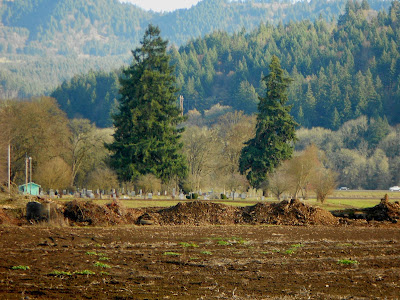
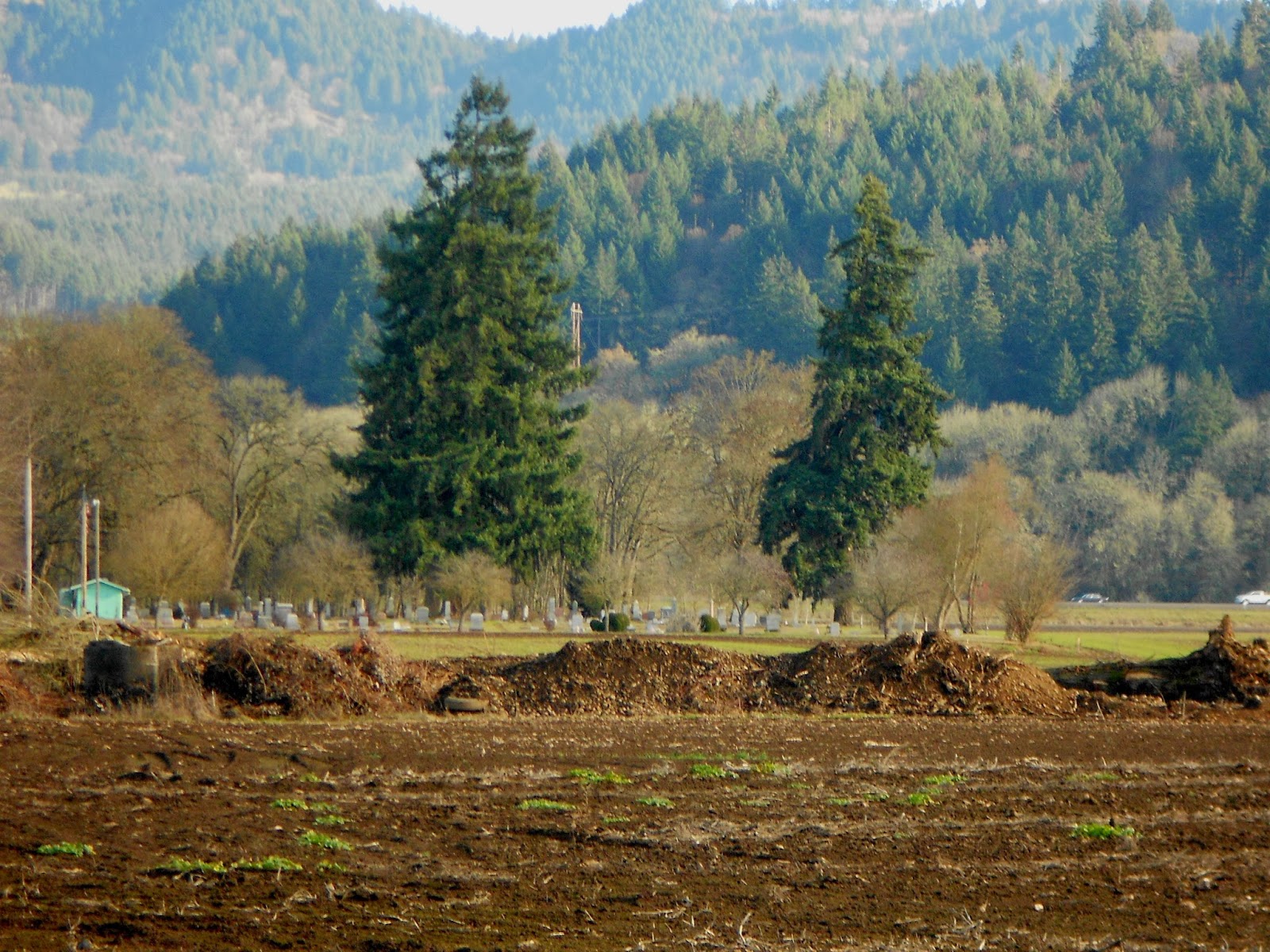
That big hill I passed so many times on the freeway that signaled the entrance to my Eugene home, the one with the columnar basalt surface that looks so interesting, and is probably the result of much mining, overlooks the land in a protective way. The freeway runs through that part of the valley just like a constant river, but in the little graveyard I could hear the kinglets in the incredibly large old Doug fir that sits right in the center of the plots, lying quietly in the shade of the Coburg Hills.
 William Tyler Vaughan and his wife Phebe still lie there, buried over a century ago. Uncle Billy's son Thomas J. Vaughan and his wife Elizabeth are there, too, with a bigger headstone. Another of William T.'s sons, John Quincy, is also buried there with his wife, Flora.
John Quincy was interviewed by Fred Lockley and told the very amusing story of his father's original trip out west in 1845. They were living in Missouri when a neighbor asked Uncle Billy to accompany him for a couple of days to help him handle his large cattle herd. Apparently after two days he was tempted to take the whole trip, although he didn't want to leave "the old woman" without any money, so someone was sent back with some money he borrowed to tide her over until he came back. He said he would be back in a couple of years, and if he liked Oregon, they would move there. This train turned out to be the lost wagon train that took the Meek Cutoff, about which much has been written. Despite the difficult journey, he was committed to Oregon.
He had nine children at the time, and in farm families all children worked, so with his large group of sons, he may not have been so necessary to the family that they couldn't get along without him, but of course I wonder how Phebe felt about it. Looking at their photos, I wonder if maybe he was irascible and some amount of trouble. In any case, he did return and in 1847 the whole family arrived in the Willamette Valley. According to family history Phebe Hazlett Vaughan was English, and was tall, stately and dignified, wrote a perfect hand, and dressed elegantly in silk and satin. On their trip west he brought the first purebred sheep to the Willamette Valley, though they left Missouri with 258 sheep and had only 100 when they got to Oregon. After less than a year on their 640 acres just over the Lane County line
in Linn County, William was off to Sutter's Mill in the Gold Rush of
1849. He returned with a fortune, and went again with his two oldest
sons to California, twice. They apparently made almost $20,000 mining gold, which no doubt funded their subsequent land purchases.
The land he chose was a peninsula next to the river, and somewhere I have a map of the donation land claim. Thomas later bought another 320 acres inside Lane County. I have a lot of questions about the Vaughans, and it was exciting in a quiet way to see their graves and imagine all of them there, living and dead. The big fir in the center was most likely one of the original trees on the plot, so all of them stood in its shade as I did. Six hundred and forty acres is a huge tract, so all of the land around the cemetery was theirs, at first.
Floyd G. Vaughan was another of William T.'s sons,and must have stayed home to farm when the older young men went to California. His wife, Angeline Baber, was blind, and he had a special seat in the wagon for her, but when she was 47 she fell from the wagon and was killed. Her grave is there, and I expected to find some of her children buried there, but there were no other headstones near her. He went on to marry Miranda and have more children, including Grace and Bilyeu, and bought property near the Huddleston DLC, which later included my little piece.
Even though Coburg is only eight or ten miles from Eugene, it was a strenuous ride for me, as I am quite out of shape, but despite the traffic on the way back, I thoroughly enjoyed the day. I didn't even look at any antiques, so I have a reason to go back. I guess they have a Heritage festival in February, so I'll have to see what that's about. There may be a lot of Vaughan heritage still in Coburg, or at least I can imagine it to be so. I can find all kinds of old stuff and imagine it was theirs. There are also many descendants, and other associated families like the Barbers to look at. My aunt Lud used to work for a John Barber, an attorney. Maybe we are closer than we think to our history. I keep running across these family names, shared by people I know, whom I have never asked about their heritage. So many things to investigate!

That big hill I passed so many times on the freeway that signaled the entrance to my Eugene home, the one with the columnar basalt surface that looks so interesting, and is probably the result of much mining, overlooks the land in a protective way. The freeway runs through that part of the valley just like a constant river, but in the little graveyard I could hear the kinglets in the incredibly large old Doug fir that sits right in the center of the plots, lying quietly in the shade of the Coburg Hills.
 William Tyler Vaughan and his wife Phebe still lie there, buried over a century ago. Uncle Billy's son Thomas J. Vaughan and his wife Elizabeth are there, too, with a bigger headstone. Another of William T.'s sons, John Quincy, is also buried there with his wife, Flora.
John Quincy was interviewed by Fred Lockley and told the very amusing story of his father's original trip out west in 1845. They were living in Missouri when a neighbor asked Uncle Billy to accompany him for a couple of days to help him handle his large cattle herd. Apparently after two days he was tempted to take the whole trip, although he didn't want to leave "the old woman" without any money, so someone was sent back with some money he borrowed to tide her over until he came back. He said he would be back in a couple of years, and if he liked Oregon, they would move there. This train turned out to be the lost wagon train that took the Meek Cutoff, about which much has been written. Despite the difficult journey, he was committed to Oregon.
 |
| William Tyler Vaughan |
The land he chose was a peninsula next to the river, and somewhere I have a map of the donation land claim. Thomas later bought another 320 acres inside Lane County. I have a lot of questions about the Vaughans, and it was exciting in a quiet way to see their graves and imagine all of them there, living and dead. The big fir in the center was most likely one of the original trees on the plot, so all of them stood in its shade as I did. Six hundred and forty acres is a huge tract, so all of the land around the cemetery was theirs, at first.
 |
| Angeline Baber Vaughan |
Even though Coburg is only eight or ten miles from Eugene, it was a strenuous ride for me, as I am quite out of shape, but despite the traffic on the way back, I thoroughly enjoyed the day. I didn't even look at any antiques, so I have a reason to go back. I guess they have a Heritage festival in February, so I'll have to see what that's about. There may be a lot of Vaughan heritage still in Coburg, or at least I can imagine it to be so. I can find all kinds of old stuff and imagine it was theirs. There are also many descendants, and other associated families like the Barbers to look at. My aunt Lud used to work for a John Barber, an attorney. Maybe we are closer than we think to our history. I keep running across these family names, shared by people I know, whom I have never asked about their heritage. So many things to investigate!

Ah, the Offseason.
As I write the sun is trying to dispel the fog we've been living in for a couple of weeks, and if the sun succeeds in coming out I will have to get outside myself. No excuses. It's time to start the pruning, which I love, and continue the many small projects in the yard. In the house, it is time for cleaning, writing, slimming down the reading pile, and all of those life maintenance tasks I was happy to put aside for a month or two while I focused on selling.
It takes quite an effort to unhook from the production/marketing/consuming treadmill but I like to make a solid break for at least a few days, before I do the inventory and organizing necessary to move into the next retail year. My piles of shirts are a little smaller, and I will have plenty to start the next season, so I am not pushing myself to resume being productive in the shop. I'd like to clear it out to do some different projects.
I still have a lot of blank silk scarves to paint, and could pick up my interest in that, using the new dyes I bought and steaming the scarves for more luscious results. Maybe someday. I have a few sewing projects I want to finish, but I hesitate to turn my living room into a sewing room again. I put away all the Xmas doodads yesterday and cleaned a few shelves. I am trying to be in the getting-rid-of-things mode and am having some small successes there. I can combine these by taking a pile of books to donate to the library, which gets me outside, walking, and gives me a little goal. Little goals work better for me than big ones.
Mostly I want to re-immerse in my research and writing. I am just on the verge of putting my book into physical form, printing out some essays and starting to make it booklike. I know a lot of what I am interested in writing right now will be backstory in the research files and not be the book, but I still have to write it, and that means investing the time. Now I will have the time.
It is also the beginning of the Jell-O Art quarter, aiming toward the 26th Annual Jell-O Art Show on March 29. Thanks to the powers who set the date not for the first Saturday in April, which is of course Opening Day of Saturday Market (43rd annual? 44th?) It's darn hard to do both on the same day. I won't have to, so I can fully immerse in whatever the show turns out to be, and the process will be as fun as the result. I plan to be much calmer about it this year, now that I know I can sing on stage without any undue attention being paid, can just be a part of it instead of the Queen, with all of her important duties. I will still be the Queen, of course, but after two years I will not have to make it all about me anymore. I have an idea for the piece and am scanning the culture for funny bits to form the show around. Perhaps I should practice twerking, since I have a feeling my hips might need some updated moves for that. It's quite tricky to find cultural issues which are going to last until April. Miley may be old news by then (one can hope.)
I'm putting meetings on my calendar today and seeing how the weeks fill up, but there are still nice long gaps in there to do what I want. I'm considering reading through the 80-some original Lockley notebooks at UO (I suppose one has to read the microfilm nowadays) because I find it unlikely that he did not interview Samantha Huddleston, and maybe even her mother Catharine Davis, and maybe more of the Vaughans. The interview he did with John Quincy Vaughan was delightful and there could be more that didn't make it into the library compilations. Although William Tyler Vaughan was colorful and there are some good stories, he doesn't figure that importantly in my particular interest, but I can speculate how he impacted the lives of his children and grandchildren. I love reading the entries by all of the pioneers, especially the daily-life types of things. People went through hardships we might have been too weak to survive, and of course many of them did not. Big families and multiple marriages were common, and I love going to graveyards, so one of the first items on my list is to go to the Coburg IOOF cemetary, which I believe is actually on Vaughan land in Coburg. I want to see Angeline's grave (F.G. Vaughan's first wife) and see about the children she had with F.G., and the children Miranda had when she married Floyd. Lots of little details I want to get straight.
Writing about the early days of these settlers is practically fiction-writing, so I'm looking forward to it. Guess I had better get to it. The sun seems serious about today, so a bike ride to Coburg could be a fine idea. Certainly cannot stay inside if there is going to be sun. Be right back!
It takes quite an effort to unhook from the production/marketing/consuming treadmill but I like to make a solid break for at least a few days, before I do the inventory and organizing necessary to move into the next retail year. My piles of shirts are a little smaller, and I will have plenty to start the next season, so I am not pushing myself to resume being productive in the shop. I'd like to clear it out to do some different projects.
I still have a lot of blank silk scarves to paint, and could pick up my interest in that, using the new dyes I bought and steaming the scarves for more luscious results. Maybe someday. I have a few sewing projects I want to finish, but I hesitate to turn my living room into a sewing room again. I put away all the Xmas doodads yesterday and cleaned a few shelves. I am trying to be in the getting-rid-of-things mode and am having some small successes there. I can combine these by taking a pile of books to donate to the library, which gets me outside, walking, and gives me a little goal. Little goals work better for me than big ones.
Mostly I want to re-immerse in my research and writing. I am just on the verge of putting my book into physical form, printing out some essays and starting to make it booklike. I know a lot of what I am interested in writing right now will be backstory in the research files and not be the book, but I still have to write it, and that means investing the time. Now I will have the time.
It is also the beginning of the Jell-O Art quarter, aiming toward the 26th Annual Jell-O Art Show on March 29. Thanks to the powers who set the date not for the first Saturday in April, which is of course Opening Day of Saturday Market (43rd annual? 44th?) It's darn hard to do both on the same day. I won't have to, so I can fully immerse in whatever the show turns out to be, and the process will be as fun as the result. I plan to be much calmer about it this year, now that I know I can sing on stage without any undue attention being paid, can just be a part of it instead of the Queen, with all of her important duties. I will still be the Queen, of course, but after two years I will not have to make it all about me anymore. I have an idea for the piece and am scanning the culture for funny bits to form the show around. Perhaps I should practice twerking, since I have a feeling my hips might need some updated moves for that. It's quite tricky to find cultural issues which are going to last until April. Miley may be old news by then (one can hope.)
I'm putting meetings on my calendar today and seeing how the weeks fill up, but there are still nice long gaps in there to do what I want. I'm considering reading through the 80-some original Lockley notebooks at UO (I suppose one has to read the microfilm nowadays) because I find it unlikely that he did not interview Samantha Huddleston, and maybe even her mother Catharine Davis, and maybe more of the Vaughans. The interview he did with John Quincy Vaughan was delightful and there could be more that didn't make it into the library compilations. Although William Tyler Vaughan was colorful and there are some good stories, he doesn't figure that importantly in my particular interest, but I can speculate how he impacted the lives of his children and grandchildren. I love reading the entries by all of the pioneers, especially the daily-life types of things. People went through hardships we might have been too weak to survive, and of course many of them did not. Big families and multiple marriages were common, and I love going to graveyards, so one of the first items on my list is to go to the Coburg IOOF cemetary, which I believe is actually on Vaughan land in Coburg. I want to see Angeline's grave (F.G. Vaughan's first wife) and see about the children she had with F.G., and the children Miranda had when she married Floyd. Lots of little details I want to get straight.
Writing about the early days of these settlers is practically fiction-writing, so I'm looking forward to it. Guess I had better get to it. The sun seems serious about today, so a bike ride to Coburg could be a fine idea. Certainly cannot stay inside if there is going to be sun. Be right back!
Sunday, December 8, 2013
Turning Everything to Silver and Gold
My pipes are well insulated now, but I remember when the drains would freeze and I'd wash dishes in the bathtub. The snow is still too deep for my bike and trailer, but I have a car, and it starts. My house is at 55 degrees, but I have lots of clean socks, and boots, and that makes me one of the luckiest people I know today.
Yesterday was traumatic, not a good day to be one of the overly empathetic. It was hard enough on people getting to Friday's load-in, not to mention Saturday. Our Market looked full compared to the Farmers' and the Authors fair. I'm guessing any weekend event blew their budget yesterday. Still, the mood was good as Market began, vendors and supporters coming in on skiis, sleds, everyone changing from boots to indoor shoes, spreading out our offerings as if it were a normal Saturday in December, meaning fully stocked and with expectations running high.
Then a broken pipe in the ceiling of Holiday Hall let loose a deluge. Susanna's vinegars stood in a ten-shower stall as vendors and staff ran for tubs and towels and the showers spread and the ceiling tiles crumbled. In a matter of minutes the water was turned off, as well as the electricity, and each and every booth in Holiday Hall was shut down for the day.
 Beth circled them up and took the lead. She promised to do everything she could for them, and if you know Beth, you know that everything she can do has been tested and will go beyond all of the things that came to your mind. Within the hour all of our members who could be were relocated, either in the lobby, or temporarily in one of the booths of the many members who hadn't been able to make it down their particular hills. Probably none of them had the sales they had expected, and all the work they had done to their displays and arrangements had to be done again, but creativity is problem-solving, and most of us are rather good at it.
A fund was started to offer some immediate relief, and I'm guessing there might be a Kareng Fund application or two. Longer-term relief will come as the situation settles out. People cried and hugged, and helped. Everybody helped. In the Main Hall, it was possible to not even know that all of that had happened.
Business as usual, hard times are hard, but we do know how to pick ourselves up and start smiling again. Even Susanne just kept working, drying off her products and assessing her immediate future. It occurred to me later that some people got drenched. No one whined.
 I can't count the number of times I have said we had a hard year. Last year was a hard year too, and we were talking about the years when we had booths still outside in December. This is just not an easy life. You have got to have some inner resources when you break your foot or your car or your top shelf with the fifteen mugs on it. Oh yes, that happened yesterday too.(Not the foot, that was last year, though other people broke other body parts more recently.)
Resilience is the key. You get right up, accept the hugs and generosity and get back to work. Forced to stay home? You make more stock for next week, because our silver lining is that we do get next week. It will probably be cold and rainy, but that will feel normal. Troublesome is normal.
Why do we even expect things to be easy? A few things are, like helping in crisis, and responding to need. Yet, not so easy to watch people get sick and leave us, to figure out what to say, how to be compassionate within your own trauma, your own damage. How do you provide real comfort when small pleasures and gestures may be all that is available? It is a stumbly way, like navigating the streets with two inches of packed ice on them. Do not fall.
But if you do, do it right in the open in a community like ours. Someone will pick up your spilled groceries, hold your hand, look into your eyes. Someone wants to be there for you. It isn't easy for them, and it isn't easy for you. Not really for anyone. We all have something holding us down, keeping us back, tripping us up.
It will be okay. All will be well, as Vi has been known to say. Things happen and sometimes they are poop. When the poop headline hit the papers last summer, we thought it had the potential to kill our Market. I can laugh now, but that was huge, and yet, we played an important part in fixing that problem. Now people are viscerally aware that everyone poops, and they need a place to do that. One less thing that gets shuffled into the closet of compassion fatigue.
Each little thing makes the big picture, and the big picture is still an expansive landscape like one of Tim's photos, fractally filled with detail like one of his little botanicals. Every little raindrop holds a reflection like Katharine's dew photos. Things are just not simple, and they do not remain the same. The snow will become legend, and maybe next year we will use the Atrium instead of Holiday Hall. We don't see the opportunities in the same way we don't see the disasters coming. All we can really do is stay positive, flexible, and resilient. And sometimes we fight for what we need, fighting kindly in our way.
Don't forget that we are survivors, and our hearts are working, and we can always do more, and do it better. Just keep doing your best. There will be another Saturday, and another glorious morning, and we will learn some more about grace and love. Keep opening. It hurts a little, but sometimes it brings the help we need.
Better go check the pipes in the shop and put on a third pair of socks. See you at Holiday Market!
Oh yes: THANK YOU.

Yesterday was traumatic, not a good day to be one of the overly empathetic. It was hard enough on people getting to Friday's load-in, not to mention Saturday. Our Market looked full compared to the Farmers' and the Authors fair. I'm guessing any weekend event blew their budget yesterday. Still, the mood was good as Market began, vendors and supporters coming in on skiis, sleds, everyone changing from boots to indoor shoes, spreading out our offerings as if it were a normal Saturday in December, meaning fully stocked and with expectations running high.
Then a broken pipe in the ceiling of Holiday Hall let loose a deluge. Susanna's vinegars stood in a ten-shower stall as vendors and staff ran for tubs and towels and the showers spread and the ceiling tiles crumbled. In a matter of minutes the water was turned off, as well as the electricity, and each and every booth in Holiday Hall was shut down for the day.

A fund was started to offer some immediate relief, and I'm guessing there might be a Kareng Fund application or two. Longer-term relief will come as the situation settles out. People cried and hugged, and helped. Everybody helped. In the Main Hall, it was possible to not even know that all of that had happened.
Business as usual, hard times are hard, but we do know how to pick ourselves up and start smiling again. Even Susanne just kept working, drying off her products and assessing her immediate future. It occurred to me later that some people got drenched. No one whined.

Resilience is the key. You get right up, accept the hugs and generosity and get back to work. Forced to stay home? You make more stock for next week, because our silver lining is that we do get next week. It will probably be cold and rainy, but that will feel normal. Troublesome is normal.
Why do we even expect things to be easy? A few things are, like helping in crisis, and responding to need. Yet, not so easy to watch people get sick and leave us, to figure out what to say, how to be compassionate within your own trauma, your own damage. How do you provide real comfort when small pleasures and gestures may be all that is available? It is a stumbly way, like navigating the streets with two inches of packed ice on them. Do not fall.
But if you do, do it right in the open in a community like ours. Someone will pick up your spilled groceries, hold your hand, look into your eyes. Someone wants to be there for you. It isn't easy for them, and it isn't easy for you. Not really for anyone. We all have something holding us down, keeping us back, tripping us up.
It will be okay. All will be well, as Vi has been known to say. Things happen and sometimes they are poop. When the poop headline hit the papers last summer, we thought it had the potential to kill our Market. I can laugh now, but that was huge, and yet, we played an important part in fixing that problem. Now people are viscerally aware that everyone poops, and they need a place to do that. One less thing that gets shuffled into the closet of compassion fatigue.
Each little thing makes the big picture, and the big picture is still an expansive landscape like one of Tim's photos, fractally filled with detail like one of his little botanicals. Every little raindrop holds a reflection like Katharine's dew photos. Things are just not simple, and they do not remain the same. The snow will become legend, and maybe next year we will use the Atrium instead of Holiday Hall. We don't see the opportunities in the same way we don't see the disasters coming. All we can really do is stay positive, flexible, and resilient. And sometimes we fight for what we need, fighting kindly in our way.
Don't forget that we are survivors, and our hearts are working, and we can always do more, and do it better. Just keep doing your best. There will be another Saturday, and another glorious morning, and we will learn some more about grace and love. Keep opening. It hurts a little, but sometimes it brings the help we need.
Better go check the pipes in the shop and put on a third pair of socks. See you at Holiday Market!
Oh yes: THANK YOU.

Sunday, December 1, 2013
Caring Indoors
 Day three of the three-day weekend. I am always surprised how tired I get. Today I apparently slept through my alarm, highly unusual behavior for me, so maybe I am not supposed to take the time to write today. I don't seem to have a clear point (not so unusual...)
Holiday Market is so irresistible to me. I try hard to stay in my booth but am compelled to see the new crafts and artists, and the progress of the ones I know from previous years, marking time by artistic progression. I found so many things I wanted or needed. I tried to support some of the new artists who were trying HM for the first time, trying to make them "fall in love fast" as I said in my last post. Here is a pile from last week. This week I will have a much smaller pile, as I was far too busy making sales yesterday to even make it to the farm, as I call it when I hurry down the hall to the farmers' market room.
 Most of us who sell outside have a palpable sense of relief when we walk into the doors at the Fairgrounds, dressed in our nice clothes, without our many layers, ready to focus on our friends and neighbors who come to see the gallery that is ours. We relax as the facets of our jobs shift slightly to a different focus, as the sometimes desperate feeling wanes, as we increase our trust in ourselves and our choices. I know I will do well. I don't have to worry about it at all. I can look at the totals of my past years (I have sold at every Holiday Market we've had, from the first when we invented it.) This trust turns to pure love as we deepen our friendships and our enjoyment of our community.
It's always enlightening to see the new people who don't quite see our existing culture, the ones who pack early or complain about the management when "the management" is walking by, the ones who don't sell well and get desperate and hawk their wares to our guests, the ones who sell out because their prices are too low,or sell little because their prices are too high. The Holiday Market at its best is not a discount show. We don't offer early bird specials or loss leaders or any other tricks to get our potential customers in the door. We dress ourselves up and try to present a warm, rich, gorgeous showing of us at our very best.
The complaining ones don't see the deep love that is going around the room, the neighborhood alliances and romances and new friendships and history and joy. They miss some of what is running under the surface, the river we ride in and the strength of its flow. We're not perfect, but we are us.
I try to help with bringing others in with us. The first weekend Art Bag project was a perfect try at bringing people in. Yes, it was transparent that we were trying to get more shoppers and booths to commit to the first weekend. We had a lot of empty booths last year and far fewer this year. A practical look at the costs and returns leads some to just sell on the sure-thing December weekends, but the bag project worked for me and I made more money the first weekend than last year. And, in a bigger surprise, I sold more bags.
I will admit that because I sell canvas bags, as well as print the ones the Market sells, I made the complaint that the bag project was going to cost me. I fell into a petty space, and I could feel that it was petty, but I learned that lesson one more time. If it feels petty, just quit it. I was wrong. The bag project served to raise the interest in canvas bags, and aligned with the plastic bag ban in Eugene and other cities, bags are more popular and needed, and Saturday/Holiday Market is now known as the place to get the good bags.
This will, of course, be of direct benefit to me, even if all of my fellow members develop and sell a bag. It's like selling tie-dye in the tie-dye capital of the Universe. People come. They want the selection and variety and artistic expression that we do so well. Those 46 bags with the 46 recognizable artistic styles were a joy to see and touch and the people who won them were more than delighted. To our credit, we did not take their addresses and add them to our database. We simply gave the bags away. Joyfully and with our whole hearts. We were us at our best.
Much is made of the consistently amazing philanthropy of my other organization, the OCF, but people may not see our quieter form of this at Saturday Market. We give free space, even the costly HM space, to nonprofits every week, where they can sell handmade items and raise funds for their organizations. Womenspace runs the coat check/ package wrap tables in the front of the room. We have buskers, and there are many, many people who seek to attach themselves to our success. We are happy to share.
What is more, we formed our own emergency relief fund, called the Kareng (caring) Fund. I'll write more about it, but I just want to announce that we have started a little bag project of our own. I say we because I serve on the Kareng Fund Board, with eight other kind folks. The Fund is ten years old, and has given out over $20,000 in grants to artisans in crisis, with career-threatening situations or injuries. Almost all of our funds have come from Market members and friends, and from the fundraising efforts we do at the Holiday Market.
In the coming weeks I will post pictures of our latest good idea, more tote bags! We decided to ask artists to decorate the back of our Kareng Fund bags (with the Market basket filled with hearts) for us. I have collected several now and this week I will get them photographed. They are sweet! This time Market members will indeed be eligible to win one, but these come with a cost, and will be auctioned off on the last weekend.
.JPG)
This year we applied and hope to be granted our own 501c3 status. We now serve not just Market members but any low-income self-employed artisan in Oregon. That means OCF members, LCFM members, and those from other towns in our state. We will be doing more outreach and making ourselves known in the next year (still waiting to hear from the IRS regarding our status, though once we do gain it, donations will be retroactively tax-deductible.)
I know many people don't know about the KF, so come ask me if you have questions. We are always accepting donations through the Saturday Market office, and will be mounting our campaign this week. Be part of us. The working poor, the self-employed, have not had an easy decade. Some of us are so far below the poverty level we may never rise above it (certainly not on our Social Security income.) We need each other. We are the safety net that we have woven for ourselves and our community.
Give of yourself this season. It is about so much more than cheap appliances and sock sales. We don't have kettles and bells, but you can find us at the Holiday Market. We want you in our family.
I will be there by the south side doors, near the entrance to Holiday Hall where the nonprofits put up their tables. Wave
at me as you take a few bucks in there and help your neighbors. Stay small and make big changes. I know when I broke my heel and a lovely card came in the mail with an unexpected grant, I cried big tears. It was not about the money, which of course I badly needed for my three months of immobility and year of recovery, it was about the caring. I felt held in the hands of my people.
Let's hold out our hands, and hold each other. Not just now, but especially now, when there is so much we need and so much we want. Presents, yes, but also presence. I will try to be here for you. Thank you, from my heart, for being here for me.
Subscribe to:
Posts (Atom)