Wednesday, September 16, 2015

Empathy

I find myself extremely delighted (I feel delight!) that at the exact time when I find the most people I know feeling overwhelmed and distressed, an Empathy Tent is opened down at the Saturday Market! If there were ever a perfect solution for a difficult problem, this is it. My only wish is that it would be so well-used that it would be open and staffed every week and made a permanent, essential part of the Market.

Long ago there was a booth called The Lucy Booth where advice was offered for 5 cents. Evolution of counseling and human interactions has made advice a quantity a bit less useful, but the real activity that went on then and is going on now was, and is, listening. Simple focus and compassionate listening to a person with a problem (or several problems) is known to be far more effective than many other calming techniques. It matters a lot that someone cares.

Mark Roberts, who had the vision and energy to start the Empathy Tent, is a longtime practitioner of careful and compassionate listening. His older brother suffered from polio which he did not allow to stop him from engaging fully in life and he set an inspiring example of overcoming obstacles and encouraging others to do the same. Mark took up the challenge to move obstacles with personal power, and by engaging others who share the goals of improving our lives for a happier world, he has opened many avenues for people to help themselves find workable solutions to whatever they face. Obstacles are problems with solutions. Steps can be replaced with ramps, door handles with automatic openers, walls can be fitted with doors. It takes will and it takes action, and all of it starts with defining needs and working to solve problems, one step at a time.

The first step is figuring out the need driving the distress and the empathy of a caring listener can be so helpful in figuring out what the underlying need is. Humans can complicate their experiences and layer distresses very effectively, masking their real needs and putting up their own walls to stand between them and getting what they need. We all experience the subtle ways we get in our own way. Often we can't see through the distress to identify what are feelings, misconceptions, assumptions, or denial of what is really bothering us. There are a multitude of ways we can confuse our issues and overwhelm ourselves, making logical choices and actions really hard to find.

The compassionate listener doesn't tell us what to do or what we are feeling or thinking. In my experience, a good listener might reflect what she is hearing or what appears to be the presenting emotion, or just offer a kind look or word to encourage me to go further with my presentation of what's wrong. I am the one who has to feel my emotions, sort them out, and figure out what action I can take to fix my problem. I'm not helpless and don't like the feeling of helplessness, so I don't generally ask for help. I might start to act out my distress: withdraw, get angry at some frustration, take out my frustration on someone else in some altercation that I am drawn into seemingly without my intention. It's easy to take a further step to blame whatever or whomever got caught up in my acting-out. None of these actions bring real relief and can be very distracting.

Years of experience have taught me a few things to listen for to help me see I am irrationally acting out instead of feeling my actual feelings. I might fall into some negative "cognitive errors" (lots of online sources outline these in further detail. I linked to one but haven't really read it...just a place to start.) These are common ways of thinking that take us further away from the problem-solving and into the distress. For me they are commonly control fallacies like thinking I am the one who has to fix the problem, and I can't, or catastrophizing (the Market will die because of this!). I do lots of other things like making things into black-and-white dichotomies that don't have any nuances, (polarized thinking) or magnifying the negative without remembering the positive (filtering). These ways of thinking are easy to fall into and culturally available and supported, particularly if you watch television. All the sit-coms and soap operas display actors falling into these avenues of error and we might see these actors as role models. It seems okay to freak out and do things and then apologize or pick up the pieces. We call it "losing it" or "blowing off steam" and it isn't even seen as violence but we are taught we are helpless to change that pattern and that it is "hard-wired" and helpful. Increasingly we witness people taking their stress out on others and it is so harmful and destructive. Often people just walk away shaking their heads, unable to respond. We aren't taught more boring, productive ways to solve problems from sources such as TV. In fact, these events are juicy and entertaining and often make the news. You don't generally see news stories about people who engage in warm problem-solving interactions that de-escalate the distress and calm the participants so they can think clearly.

But through people like Marshall Rosenberg and countless others we can be introduced to way more productive ways to make life easier and more productive without so much of the stress and distress brought about by our thinking errors and assumptions. It's really rare that someone is out to get you. The post-office clerk or the grocery checker isn't doing or saying things to mess up your life, they are doing their work within the confines of their job situation and they might be as unhappy as you are on that particular day. You might display behavior that pushes them into their own stress reactions. It's your job to get the skills to keep your stress and issues from hurting other people. To do that job you have to do some work.

Whether you do that work in years of private therapy, in a discussion group, or in your chair with a book or the internet, the information is out there for you to learn the skills and there are lots of people who are willing to support you while you learn to practice it. Just reading about it doesn't make you able to use the skills in the situations where you need them the most. Generally, I have found, I need some other human to listen to me and hold the space for me to hear myself. I can (most times now) hear my assumptions surface and my illogical thoughts without much prompting, partly because I am an artist and my brain is trained to look at problems from lots of different angles while I try to figure out the creative solutions. Emotional problems are simply a different, more nebulous set of challenges than artistic problems, and if you don't have the skills it will be like a jeweler trying to build a rack without the woodworking tools to make it easy. I've done lots of things with bad tools and then redone them with the right tools and been amazed at the difference.

When you try to  hang a door or even change out the lockset with a dull chisel you will probably split the frame and make a messy hole around the lock, as well as mis-align the parts so the door won't close well. I have several doors in that condition, as I built this house with few skills and learned as I went. The last time I did it I was much better at it than the first time. I got better tools, learned why they need to be sharp, and was better able to use them in the proper ways to get a more finished result. Emotional issues are similar. While yelling and driving someone away may solve the immediate problem of the irritation you are feeling around them, it shifts some of your irritation to them, to people who had to watch you yell at them, and on down the line. They might take that stress you handed them and take it out on someone else. Most people are really good at personalization, taking everything that happens and thinking it is mostly about them. It is easy to set off a chain of negative thoughts in them, thinking about the things they should have done, the ways they should have defended themselves, taken control of the situation, or taking on the hurt and feeling like an inadequate person in some way, internalizing the conflict to hurt themselves.

If you could have taken your frustration to a listener and worked through it to let go of it, you could have addressed the actual problem with the other person, if there was one. You could have owned your frustration, felt the irritation as something you were believing in (not an actual fact like the temperature), and faced the issue as something that could be eased. Many of us are not in the habit of owning our feelings. Even the simple language of talking about feelings can be improved. I read a great article about phrasing yesterday: the subtle difference you feel when you say something in these three ways: I am delighted; I am feeling delighted; I feel delight. The first two created a little distance from the feeling (delight) and the third connects you to the emotion in your body and is a clear declaration of your experience. If you substitute "frustrated and frustration" into the sentences it is a little more clear. What Vika Miller says in her blog is: The first phrase ("I'm delighted/frustrated") uses English in a way that says something has been done to us, and that our experience is static or ongoing. I AM [fill in the blank] says that I'm this way all the time; it labels me and tells my brain that this experience is all there is. Both of these slow or stop the flow of Life energy ...

The second phrase ("I'm feeling delighted/frustrated") lets go of this labeling, this linguistic permanence, and acknowledges that what we're experiencing is a momentary experience, rather than what we ARE. But, it still suggests that something has been done to us.  The first one allows more energy to flow, while the second one still limits that flow somewhat...

The third phrase ("I'm feeling delight/frustration") focuses our attention on the present-moment experience arising within us, allowing all the Life energy to flow freely.


Her point is mostly that the language that we use really matters in the ways we communicate and process our emotions. These may seem like very subtle fine points but I wanted to show how the basic owning of one's emotions can help greatly in communicating and solving human-interaction problems.

Trying to find a way to control the forces that act on us might seem like our job and might seem overwhelming, but most of the ways we have learned to exert control in our society are by oppressing someone else. Most of the things we encounter cannot be controlled. Most of them have to be dealt with more creatively than that. Thanks to the internet and to the wise people in our community, we have lots of ways to start thinking about these more elegant solutions and our response to the complications of our lives. What we say and do is important, and when we are next to each other on Saturdays, in the state of vulnerability that we open ourselves to each week putting our creations on display, we are all at risk of hurting ourselves and each other if we cannot stay in our most loving human state. I'm not saying it's easy; far from it. I have to talk myself through something every week that could derail me and send me into negative thinking. I use the good listeners in my neighborhood and my friend group to help me regain my rational thoughts and not go further into my irrational assumptions. I talk to Mark, as I am lucky enough to be a friend of his and he is very generous with himself.

If I am stuck in my booth with no neighbors I'm comfortable with, and the pressure of thinking I have to be there to serve my customers above all, I can go off the rails. I see it in someone every week. Some of us are more fragile than others, more or less grounded, more or less clear in a particular moment or time. Autumn stresses me and I don't like to be cold. I worry about the declining sales on the days with the early football games. I worry about lots of things. But worrying is focusing on an outcome I don't want, so I try to use the skills I've gained to redirect my worrier warrior. I can't control the weather or the football schedule or the customer or my neighbors or much of anything besides my response. That I can, with support
, learn to control. If I do that imperfectly, I am a human being. I don't really believe in perfection.

So what I'm saying is hurrah for the Empathy Tent, and I want to encourage everyone to stop in there for a moment or several. Use this terrific resource Mark and his associates are kind enough to provide us when we need it so much. Use the available resources. Learn more: Oregon Network for Compassionate Communication. Read more, think more, even feel your feelings more. Don't think you have to tough things out like a pioneer or a buccaneer. We live in an age of abundant resources. Give yourself the gift of empathy. Take care of yourself, and that will make life more wonderful for all of us. I pledge to do my best to do the same.

Thursday, September 10, 2015

IMHO

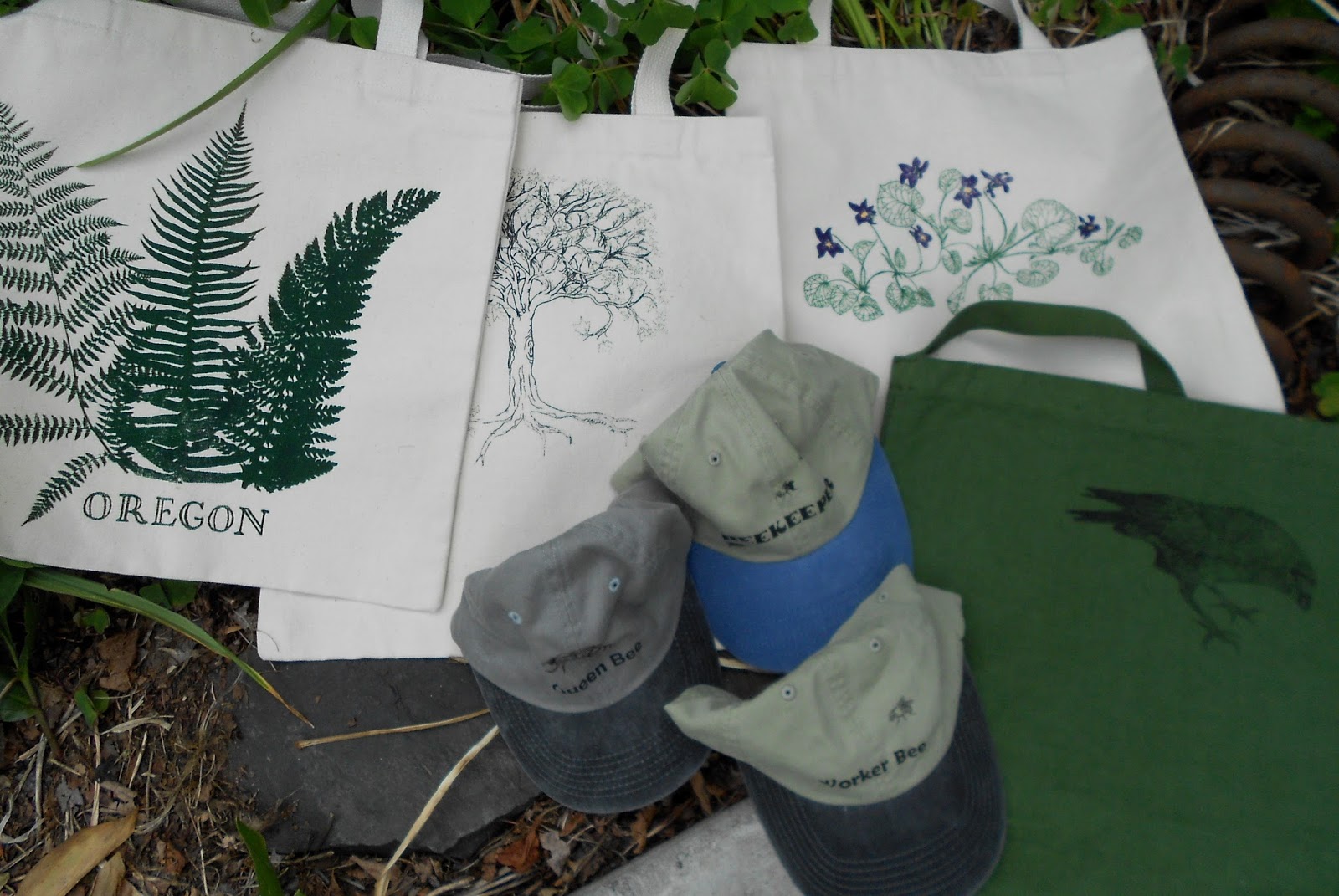
Okay, I have to say something to my 30 loyal readers. This is my own opinion and no official thing, and I will restrict my sources to the Eugene Weekly Biz Beat and pretend I know nothing else about the soap fragrance issue. I'm the Secretary of the Market, but this is not a blog by the Secretary of the Market. This is an essay from the little old lady on Medicare who prints tote bags and hats with a little squeegee in my cramped little shop. As you might have read in my post from yesterday, I have probably come down to 8th and Oak to sell about a thousand times. That gives me about the same selling rights and advantages as the person who comes for the first time. We are a community that seeks equality. Not just for us, the ones who pay fees, but for the people who come down to do yoga on the lawn, to drum over there in the wild and free zone, or just to watch other people doing those things. We are free and we are open, 10-5, Rain or Shine. And thus it has been since 1970.

I've sold at the Market for 40 years. I've sat on the Board, taken thousands of hours of minutes of that body and various committees, served on a few Task Forces, study groups, but mostly I have stood in my 8x8 and observed the place. It's the Community Gathering Place. It's what the commons used to be, since that no longer exists in the modern town of practically everywhere. Pretty much anyone can come down there and do pretty much anything they want, but over the forty years the people who gather to oversee and nurture the Saturday Market have had to place a few limits on the commons when we are using them. Renting them, to be correct. We made a few rules. Not everyone follows them, of course.

Above all, the health and safety of every person who steps on the block is our concern, and not because liability insurance exists, but because it is right. Everyone from the newest babies to the practically ephemeral comes to our Market. Each person is under my protection, the protection of the community I am a part of. I choose to pay my fees and set up my wares and my (not at all "makeshift") business, and I make agreements when I do that. I agree to our Code of Conduct, and to all of the spoken and unspoken agreements of a polite and cooperative society.

So when I get hurt or mad I take care of it. I get counselling or check things out with my neighbors and friends and that is how I right my own ship and keep my relationship with the Saturday Market clean. I'm writing this with a bit of passion and normally I might not publish it right away, but since I made such a strong disclaimer I think I will just throw it out there. I might hang onto my hurt for awhile or I might see the error of my ways, but I have learned (imperfectly) to take responsibility for my own behavior and my thoughts. I expect that of everyone else too, though it is a lot to expect. So again, these are my thoughts, one little old lady in a town of what, 120,000? One voice.

I know people live in that park when I am not renting my little square. I know they must be worse off than me because I have a roof over my head when I go home. I have a car to move into if it gets that bad. I don't like it when those other park users make my life harder by leaving their waste and garbage in my space, but if I am the leader of the Market I ask the city to rent some porta-potties for the people who need them. Our Market spends a ton of money renting multiple ones for Saturdays, and I pay for that. I want my customers, my friends, and my fellow humans to be safe from disease and if possible, discomfort as well. It doesn't take that much thought to provide basic services. Wash your hands. If you run a newspaper, how about not putting in a headline about human waste being found at the Market? That hurt, but if Eugene is anything it is pretty sensible and that one didn't cause as much harm as we feared. People knew that the problem wasn't confined to that location, but was a worldwide problem. Everybody poops.

If I can't eat dairy (which is increasingly true, personally) I don't demand that every booth serve a dairy-free  alternative for me, but I do take my money to support those who do. If they're people I can ask, I get a dish without cheese. If it's wheat, I get a gluten-free crepe or muffin or whatever I need. I don't think that is my right, necessarily, but in a community it is great when we see each others' needs and try to fill them. I find many, many instances of my special needs being important considerations for other people, and vice-versa. I don't use PVC-based ink in my products, because the people who make the PVC die from it. I'm not going to contribute to that if I can help it. Everybody ought to be able to find a job that doesn't kill them, everybody ought to feel like they belong to a society that sees them and hears them.

Of course I know a lot of people after all this time, and I wouldn't keep coming back if my needs didn't get met. I've learned to ask instead of demand, but when it comes to something like my health or safety, I keep asking until I feel safe. Did you know we are a smoke-free market? It's our workplace. Did you know dogs sometimes pee on our booth corners and our weight bags? That's one reason we don't allow pets. Another is that some little people and not-so-little people are afraid of dogs. It's easy enough to ask that people don't bring animals to the Market. Those food booths are restaurants, and they like it clean. In all forty years I have never been sickened by anything at Market, with the exception of the behavior of people who don't seem to know how to live in community. You may love your dog, but love them at home, if you don't mind.

I don't have a single problem with the Weekly coverage of the issue except that it shouldn't have been there. It's not "surprising" that empathetic ears were found at a meeting and a decision was still made that didn't let someone win and someone else lose. Listening is the first skill we learn to practice in group work. The organizations I love the most work within a consensus-seeking practice. That means everyone gets to listen to the concerns of everyone else, and then a solution to whatever problem or situation can be found that will be the most fair to the most people. Nobody gets dismissed, nobody is accused of following a fad or getting on a bandwagon. Pet rocks were a fad. Feeling the Bern is a bandwagon. Chemical Sensitivity is a medical condition that probably should be classified as a disability. Nobody in a consensus-seeking model is going to succeed by dismissing the health and safety concerns of someone else. I think the people of Eugene must know that, because nobody wrote a letter in response to the really surprising statement of last week's column.

I would have loved to have written a response to the Biz Beat article of last week or the one today, but I can't and won't, because I am committed to the consensus-seeking process that is the Saturday Market policy. The Standards Committee is going to take another look at the Scents policy to see if anything was overlooked, is open to misinterpretation, or if undue hardship will be placed on any individual by another. In the commons we have equal rights, in the Market we are equals. Everybody is honored, everybody gets to have their say, open their booth for business, and sell the creations that please them if they can  find people willing to buy. It's really that simple. Process is our policy and we have a lot of meetings, and some of them are long and not that fun. Still, a commitment to process, transparency and fairness has brought us a long way. Remember when the city hated us? It wasn't that long ago. We earned respect because we try to do the right thing. We take our time, we really care about it, and we work hard.

If you think you can stereotype the Saturday Market member, I am here to tell you that you can't. The incubator and start-up opportunity that we participate in is open to everyone, from the ex-Marine with PTSD from Vietnam to the ex-corporate CEO who now just wants to make wood carvings in his garage. If you make it by hand, you are welcome to try to fit yourself into our basket.

The thing is, the basket is big and thousands fit. We all have to get along. Nobody is allowed to kick a hole in it and let the love leak out. At least they are not without attending a goodly number of meetings and learning how to live in it with the rest of us. With all the many thousands of people who have sold, attended, and loved or hated the Market all these years, nobody has managed to kick a hole in the basket yet.

So process will continue and people will continue to be heard and to participate in the group to seek consensus and get their needs met. The trust is there. I don't know the outcome, and I don't bother to try to push it or pull it to fit what I want. I say my piece, and I listen to everyone who cares to comment. As Secretary I don't even have a vote, and I like it that way. As the little old lady, I have this virtual soapbox, ironic as that is at the moment. It doesn't stink.


Wednesday, September 9, 2015

A Thousand Days

Our little Saturday Market neighborhood is friendly, as a rule. We're one of those fairly well-established ones with people who have come for a long time and like to come every week, stay until 5:00, try to follow the rules. We share some of those old-hippie traits like being wary of authority, thinking the hippies were right, not exactly being sports fans...but we do try to be supportive of the home team when everyone around us is dressed in yellow and green and lots of others are in whatever colors the visiting team favors. We certainly appreciate that out-of-towners like to come and experience our Market and are sometimes hauled down there by regulars or home-town hosts who know where the fun is. My booth is a little out of the mainstream in what I like to feel is an eddy, and I suppose I might make more money in another space, but I'm at home in mine. It feels like a fine fabric that unspools from the bolt every week and glimmers in the seasonal sun or dampness in a little different color each time I look.

Raven and I like to keep our sides open to each other so we can watch each other's booths while we run to Farmer's Market or the food court, and we have our sequence of that. He gets his pastry first, then his peaches, then his coffee, and somewhere in there he leads the little parade, and I usually stay in the booth and get all of my stock and signs hung until that is finished and I go off for my second breakfast. All day long we chat and cover each other while the various purchases and discussions are held around the blocks. This week we were enjoying the rituals of thousands of Market days and thought to actually calculate an estimate of how many thousands. It turns out that at thirty years and approximately 33 Markets per year, Raven has probably reached the one-thousand-markets mark!

As this is my fortieth year, I have probably surpassed the mark, but I did spend at least ten years working on my house-building project on weekends instead of selling on Saturdays, so maybe we are at about the same place in time. It's hard to say, though I probably still have all of the receipts up in the attic. I'll be throwing those into the recycling soon I suppose. I've reached the time when I have to seriously abandon some of the good junk I've collected over the years. It's hard to know where to start. I have to admit to myself that maybe I won't make cast paper or sheets of handmade paper anymore, so could let go of the screens and tubs and handy accessories for that craft. Or maybe I won't paint silk, and could sell off the scarves and dyes, or maybe it's my comic book collection I have to get rid of. Something has to go. It seems hard now but like the roof project I'm avoiding, it won't get any easier. Raven and I also commiserate about the decline of our bodies, our spines and our nerves and our various abilities. It has been a relatively gentle decline until recently, but the direction is clear. It's hard to imagine believing that we couldn't trust anyone over 30...that was half a lifetime ago.

He got the shingles, and so did my Mom, and clearly this is something to avoid even harder than I'm avoiding that roof project I was supposed to do this summer. I went for my first Medicare appointment and although I am not old like they expected me to be, I'm going to be fitting into their system with increasing need and denial won't help. After a lifetime feeling like the ant I'm afraid I was more like the grasshopper in effect. My safety net has some really large holes in it.

On Sunday, however, I got to meet with a group of people who represent one of the best aspects of Saturday Market: the Kareng Fund Board. This fund, started by Market members about twelve years ago and funded almost completely by Market members all this time, has in the very recent past stepped up to a more solid legacy by completing the process of becoming a 501c3 non-profit. It was scary at first but we paid for a professional training and once trained, directed ourselves to think bigger. We have a couple of people in our midst who know how to do that. Alex thinks we will give a million dollars in grants. (We have a way to go, but we've given over $25,000 to date!) We expanded our granting to all independent artisans in Oregon who meet our criteria. We started asking for funding.

Our first try was the Rex Foundation, the arm of the Grateful Dead organization set up to help nonprofits thrive. We put together a grant application and asked for, and received, $5000! This will be used to increase the amount we can give from a $750 maximum to an amount more useful to those in crisis. We will also engage in more outreach so more people know about our resource. While we only fund low-income artisans (up to 200% of the poverty level) we wanted to expand our granting outside the Market community. It's not that easy to reach the people who need us.

Saturday Market has always been very kind about keeping the KF under their wing, collecting donations from the payment envelopes and hosting the basket drawings and Auction with Percussive Interludes at the Holiday Market. Many members round up their weekly percentage payments with a few cents or a couple of dollars to the Kareng Fund. It's a very simple way to support our fund, easier than finding the right change to pay the exact ten percent we owe at the end of the sales day. I welcome it, and contribute twice a week with my Tuesday earnings as well. All of those small amounts add up. The fund kind of magically hovers at about the same amount as we have given, although the recent windfall swelled the fund total to over $30,000.

It's time to give more grants! If you know anyone who is struggling with a career-threatening crisis, someone who makes money from their art by participating in some type of arts organization, send them to the Kareng Fund. Our application is online and easy to fill out. The Saturday Market office also accepts applications via our brochure, which should be widely available, but the online process is the easiest and quickest. We don't have a fancy website. We aren't a fancy group. Our potluck brunch featured homegrown tomatoes and homemade muffins. It was very warming to look around the table at this group and recognize the purity of this fund created out of simple goodness and caring for others. There is no politics, no contention, no misunderstanding connected with our mission. We occasionally discuss the nature of "career-threatening" and want to avoid funding chronic need rather than crisis, but we adopted the tagline of "a safety net for artisans." That's what we are, a small part of something sorely needed in our artisan community.

The world seems increasingly un-caring and people undergoing suffering are often on their own, particularly when they have lived the independent and often isolated lives our artist culture fosters. Isolated people often do not know where to turn when they are suddenly the ones with health issues or what I call the "life tax." When your shop is burglarized or your bike stolen, your garage burns down or your partner falls ill, you can feel quite frightened about how you will make things work. Often the self-employed fall through the cracks of government programs, or those not old enough or disabled enough to access senior or other services find no help from the local agencies. They may not have the ability or time to craft the complicated forms to apply for government programs, or trust that asking won't cause some other type of harm to come to them. We don't give a lot, but it might be just enough. We've funded things like water heaters and bus passes, purchases of inventory after a greenhouse freeze or the loss of a shop. We funded many health crises before the advent of Obamacare, and continue to do so. If you need us we want to be there for you.

We will be continuing to ask for your donations and continuing to reach out to those who need us. Don't be afraid to ask. Sure, there may be someone who needs the money more than you, but there is enough for them as well as for you. Don't be too humble to get the help you need, even if it is just the small amount we can give. We want to help. It feels good all around. A huge thank you is due to those who started and continued the work of the fund for so many years, and to all those who gave their nickels and dimes. It's simple and good. It's one step up from passing the hat and neighbor helping neighbor. Help us spread the goodness by asking, giving, and talking about us, especially to those in need. If you know someone with money they want to share, direct them our way or invite them to the auction at the HM. Together we have an impact and we can see the immediate increase in safety, health, and the ability to thrive in those we care about.

And here's to another thousand days selling at Eugene Saturday Market! I may never be rich in dollars, but I am most certainly rich in so many other ways. See you on the Park Blocks.

Sunday, August 30, 2015

Surprises Every Week

The combination of routine and the unknown every Saturday Market makes for an unfolding mix I can't resist. So often I wake tired and unwilling to mount the energy I know it will take, but I learned long ago to make no decisions in the morning. I am going. Coffee and sometimes bacon are needed and when 6:45 comes I log out of Facebook and go load up. My Tuesday commitment is only slightly less concrete. I am continually surprised at the sources of pleasure and food for thought (as well as the body) that float through my booth neighborhood. Never two days alike. Nearly always soul-stirring as well.

Yesterday so many things happened I won't be able to report on all of them. The Slug Queen did bring the Empathy Tent as well as playing onstage with his Sunday band, and I'm enjoying Markalo Parkalo immensely as he brings his style to the public. I have admired Mark Roberts for a long time due to his commitment to compassionate communication (NVC inspired by the great Marshall Rosenberg) and his own brilliance and sense of humor, as well as lack of ego and male dominance paradigm...he's just a stellar person who has made the most of his life experience and talents. He's a sweet one, restoring my sometimes tenuous faith in the human male animal. Anyway, Markalo dresses the way he wants and is quicksilver in his presentation. He is going to be a force of legend. It's fitting that there is no Eugene Celebration framing to lean on for him. He was not given the key to the city, as Bananita said so eloquently: he has to go out and find it. He's doing really wonderfully so far!

After the Coronation I was helping to clean up and happened to rescue his handwritten speech, which is essentially his promise to us, his people, and here it is. I love what handwriting reveals and he stuck to the script, promising even more between the lines.

I thought to make it into an art piece for him but used the Slug to make the headpiece instead. I bestowed him with his purple flower crown yesterday to our mutual delight and he has plans to make it part of his eclectic and ever-changing costume, which will fit his expanded role.He has already added el-wire to his pimp hat and the lovely green crown Kim Still made (she as First Lady-in-Waiting gets to make lots of Slug Queen Swag.)
  So there was that. He and I had a great chat about the Empathy Tent mid-day, mostly me reinforcing my belief that if everyone had even a little training in compassionate listening and communicating we would all make life more wonderful for each other without much effort, instead of all the self-and other-sabotage we enter into without knowing a better way to get our needs met. The Empathy Tent will have a sometimes-there presence at Saturday Market for the rest of the season, usually locating on the west block back by the south wall. Step on in with your questions and concerns. Get to know Markalo. He's Your Queen and Mine!

Lots of our members stayed home yesterday due to fears about the weather. Remember what I have said about fears and weather predictions before...there was very little rain and not much wind either yesterday, just enough to keep us on our toes. People did fine with just umbrellas, and there was no weight inspection or punitive actions and no booths went flying either. Most of the storminess went north of us although I was happy I was prepared. It wasn't easy to bring that 75 pounds of sand on my bike cart. With the repair of the fountain our longtime habit of putting one or two of our booth legs into the recess of the fountain moat is over; my popup is now skewed out into the aisle a foot on the southeast corner and I have to bungie it to keep it in place, and I'll probably need the fourth weight bag now to be in compliance with the policy. I like being in compliance with policy. I seem to have outgrown much of my rebellious bad-girl parts and given over to Miss Rule-Follower. (Not in every way, of course, but I'm 65...need a little more safety for my body.) I felt bad for those who gave into their fears and stayed home. We had so many tourists! I sold a lot of bags, too, and people were really happy to find them. I had several conversations about plastic bags and imported bags and lots of support for my line of locally made and dyed products.


There was even a moment I exchanged looks with a charismatic and gorgeous young man who turned out to be Casey Affleck, we think. He was not your usual good-looking young man, I could tell that. He had a quality of self-awareness and deep power that was either his good luck or something he has learned from being in the big world that most of us would never want to enter, if we're honest. There was a touch of fear mixed with the expectation that I had recognized him (which I didn't), and I imagine that the opportunity to live a normal day strolling the Market with his friends was very precious to him, so I'm glad I didn't know who he was. It's possible that I made up the whole story, as possible as the idea that I might have sold him a hat. I don't even know. I make stuff up, but somebody else was positive it was him and it was certainly quite possible.

Our local celebrity Rich Glauber came by to sing the almost-finished version of a new song he has written about the 1920's, another in a series of very clever and accomplished songs he seems to write with a magical access to skill and knowledge built up over years of practice. He makes it look easy but when you hear the process from the beginning you can see how he layers it up like any piece of writing. He starts with a musical phrase or an idea, and with sometimes only a note or two he can add a whole new aspect, like a little reference to a Gershwin song he threw in there. He captured the giddiness before the crash of 1929...we can look back and see it, but he doesn't foreshadow it heavily, just enough to make us think about our times now, as we see what is coming but still party like it isn't. Do people really believe we won't be able to drive cars and have plastic everything? No, they do not, but some of us are operating like this is already the case. Some of my alternative culture friends don't even accept a plastic bag, because they don't want to be part of that stream of consumerism when they decide its next use. They don't want to be the one to throw it in the trash. I'm getting to be more and more that way, saving my bath water to use for other things, cutting down my water bill and feeling like I can still grow flowers in the drought. Riding my bike even for the awkward and distant objects I do need to consume. Mostly it seems eccentric, but really lots of us hippies have always known the future will demand such skills and comfort with the less-consumptive patterns of our society.

We want to already do the right thing even before it is legislated. That's not an easy road to walk. The booth weights issue was a great example of that yesterday. Those of us who got with the program were relaxed, and those who have resisted were caught a little short. We all know that the future will catch us all short, and we recognize the human nature in avoiding and procrastinating and not working on the skills we need. When we have an emotional crisis, the same things happen if we don't gain some skills while we can.

The gossip mills were less active yesterday (or didn't reach my ears) and the Empathy Tent was well-used. Little by little we are improving, working things out. We're still getting used to life without Beth, as a community, seeing how much we depended on her to keep us together, do all the necessary counseling and keeping out ahead of our tendencies as someone who knew us so well. We commiserated yesterday about how much we still need a Mom down on the Park Blocks. Well, I don't want the position, and truly we are better off not having someone we put into that role. Everybody needs to grow up, no matter their age, not just in the Market/Fair communities but everywhere. There is nobody in charge of your emotional growth but you, though of course you cannot do it all by yourself. Look around and listen well to all the forces that are there to assist you in being a better you, having a better experience, making life more wonderful every day for each other. That was Marshall's legacy, and the unspoken wish of all those we have tragically lost in recent days from our collective society. Hurt people hurt others. Take care of your pain; get the help you need. Keep working together to work for positive change. It has never not been needed; it has never not been the way. It has always been The Way. Humbly yours and mine.

Wednesday, August 26, 2015

Old Ways

Ah, summer is winding down, long before I am ready. It might even rain on Saturday! Of course rain is really needed, but we also need the Saturday income flow...but Sunday, rain on Sunday would be fine with me. This past Sunday I actually stayed inside because of the smoke, reminding myself how much bad air we tolerate already, not so much here, where the smog isn't visible (yet) but in other places, cities mostly. One of the reasons I seldom drive.

Had an interesting chat yesterday with my neighbor at the Tuesday Market, a person half my age who is a woodcarver. He's very dedicated to the handmade ethic, thinking hard about how he can make things more handcrafted in his life, not less. I draw great hope from young people who take on the hippie values (which to be honest were probably just traditional farmer values that the hippies adopted along with all the other cultural appropriations of the alternative culture.) Certainly the direction away from more mechanized solutions to everything is my direction. I got rid of my clothes dryer at least a decade ago, and don't miss it. I have a clothesline and know how to take advantage of the weather, even in the winter. I enjoy the biking and walking and even how long it takes.

We talked a bit about the politics of the Markets and Fair and the things that have changed over the 40-year history that I know and it was hard to pin down any separation or real change. Visually, almost everyone uses pop-ups and most of the change has been so gradual it isn't noticed, but the hard parts are mostly hidden. The laser cutters and 3-D printers and other forms of automation have crept in, though thanks to the dedication of a few there is at least an awareness of it. Personally I think laser-cutting needs to be eliminated from the handcrafted market, but I can surely see how computers have aided and not always subtracted from the ways we do things. Defining "handcrafted" becomes more challenging with every meeting, for both Market and Fair, and it will be a long process to dial things back if indeed we can. He and I talked about how a person can only make so many things in a day, and prices can only go so high. I bought a cool little coffee spoon that I had been wanting, which will fit inside my coffee jar, but how many people will pay $25 for a thing you don't actually need? Maybe a lot, as the real handcrafted things become harder and harder to find. He doesn't even sand, but uses sharp tools to smooth the utensils, and they look and feel wonderful. I know I will get more than $25 worth of pleasure out of the spoon, and will have it forever. That means a lot to me.

My hope is that people value such things increasingly, but I might have to stay off places like Facebook to hold onto that hope. Every time I look there someone is saying things like the smell of line-dried sheets is amazing but they prefer the softness of those tumbled in the electric dryer. Walking is good but cars are convenient and necessary. Doing things by hand or in the old ways is too hard. We are too soft. I'm getting to be a crochety old lady about this stuff. Work is supposed to be kind of hard. Of course my work ethic is really puritanical. I do get lazy too, and there are things I will have to give up. I try to channel my fantasy Tillie Van Harken sometimes, the woman who lived here for almost twenty years and likely made many parts of my house be the way they are. She didn't even have running water until maybe the year before she died in 1942. That means she had an outhouse, heated water on the stove, and did all things inconveniently.

As far as politics go, apparently little has changed as well. I got the "while-you-are-packing-up-I-will-rant-to-you" lecture at the end of the day on Saturday. It seemed to be focused on the opinion that I am too nice and won't admit that there are people who are devious and evil and would kick other people out of Market. I am not inclined to ascribe evil motives to Market people, that is true. I make excuses for them, that they don't hear well or have good social skills or are too isolated and don't see the big picture. The gossip mills turned in an ugly fashion on Saturday and there are a couple people convinced they have to fight for their Market membership despite the fact that nobody said or is planning to kick them out and that isn't how we work. I insist on that. Like the fact that we try to work toward consensus in all of our efforts, which is largely hidden and not spoken about much, we also work very slowly when we sense important change or irrevocable actions. The whole fight for the handcrafted is a glacial, careful process.

I dislike the getting offended and going away mad thing people tend to do. It's human and happens all the time but I always feel the failure of framing that causes that reaction. These people need the empathy tent! They need to talk about their feelings and fears and shift their perspective to see the salient points and real problems and to not be caught up in those fears and emotions. It's common but not that hard to break through to better understanding. It just takes time and listening. My policy with the rants is always to listen as well as I can and point to the fears if I can, hoping to diminish them. Fears persist though. What happens is that people cause the exact outcome they fear most if they proceed to think that way. It's needless and sad.

So I hope the Slug Queen Markalo Parkalo the Empath comes back to Market this week and all of these people find their way to his tent. Empathy and good listening is needed, as well as a re-grounding in the nonviolent and compassionate. Yes, there is a problem, but yes, there are solutions still out there we haven't found together. No one needs to do anything rash or irrevocable. We are a process in motion. Wait a bit if you don't yet see it. Ask a few questions instead of making so many assumptions.

Yesterday Rich brought down his guitar for a bit of singing at the end of the day, and it was really fun. Let's all sing more. Let's look around and see what is great and working well and try not to complain so much. There is a lot of good happening all around and it is lazy of us to forget to celebrate it. It's our habit as humans to want improvement and progress but there's time to think about it a bit before we rush in and mess it all up without a solution in mind. Let's not break things we can't fix.

Like the old ways of hanging up the clothes and canning the tomatoes, things take more time to do in the traditional manner. I found it fun to get a chance to talk about the alternative culture as an old culture...it must have been something back in the mid-Seventies when the hippies gathered in Eugene and started to change things. I'm sure we were viewed with suspicion and dismay by many until the common ground was found. On that score little has changed. I'm certainly not convinced that the student housing developments and the prevalence of heat pumps and air conditioning is good change. I have to allow that some of the things I protest will indeed look sensible and elegant to me over time. I pitched my fit about the weight bags only a few months ago, but now I take my bags to the Market and strap them on, and I like them. Last Saturday it got pretty windy and people were holding down their booths, and the big one over at Farmer's Market almost went over again. I saw the usefulness, practicality and safety of the weight bags and I wanted everyone to have them. That's only one example of a change that only took me a few months, but one I couldn't imagine back in the winter when the idea surfaced.

So maybe some of the other things I fear and don't understand will become clear. Maybe I am indeed too nice and we have some devious forces that need exposure, some wrongs to right in our little community. I'll keep watching, but I don't see myself becoming less trusting of the good and honest forces among us. Help me out with your sensibility. Go to the empathy tent with your fears, instead of spreading them around all over the rest of us. Do your part to make us stronger.

And conserve water and power. We are going to need it, because that rain on Saturday might not appear. Predictions, like fears, do not always come true. Good thing.  

Sunday, August 16, 2015

All of my art life is tangled up in one weekend!

Don't have time right now to write a full post, but did want to remark upon the second Radar Angel Slug Queen, Markalo Parkalo (aka Mark Roberts). He is a fine man with superb listening and communication skills and might be the most responsive Queen ever appointed. With his practiced skills at NVC and empathetic listening, many will be able to appeal to him for all manner of assistance and support. He came around Saturday Market yesterday promising all sorts of things...our heart's desires!

I plan to pitch the Kareng Fund to him to see if we can ride his coattails a little. A Market-grown nonprofit to help artists of all kinds (the low-income ones anyway) undergoing career-threatening crises. We give grants of up to $750 (soon to probably be raised due to a grant we received for $5000) and have given about $25,000 out in the past decade. He can help us with our outreach plans I think.

Mark has been running an Empathy Tent at the Market on occasional Saturdays. It's a neutral place where skilled listeners are available to all. He does this in honor of Marshall Rosenberg and it is a needed service.
I plan to use it myself next time he appears.

Singing for him was a blast. We rehearsed slightly the night before and didn't coordinate anything. Our costumes and styles are as always left to our own artistic inspirations and that is one of the keys to understanding the Radar Angels. We shine from within, and we try to help others unfurl their wings, so you never know quite who will participate and what they will do and say. We were asked to waltz if we wished and some of us did. It felt lovely to stand in front of yet another loving Eugene crowd and sing in public. I'm still surprised that I can do that after so many years of thinking I had stage fright. Maybe I still do, but when I dress in glittery clothes and wear Jell-O my inner glamour takes over and I am simply happy to be me. Like a bird. We were described as an "entourage of strangely clad hangers-on."

I suppose we could have been seen as outsiders to the Slug Queen Coronation, but that is simply not the case. Radar Angels have always been there. Radar Angels come and go from the active performance or art participation levels. We're like the Old Queens. You can't get rid of us, and you can certainly dismiss us (repeatedly in some cases) but we're not going anywhere. We are a shining thread of the Eugene fabric. We have our wings on and our fingers in every pie. So as the royalty we are, we find our shortage of photos and accolades amusing. At least Roger Rix and Kim Still recognize us. Not to mention Maude Kerns Art Center
(see previous blogs about the Community Partners thing.)

Have to go and picnic at the Country Fair site. Tra-la! Finally the picnic is held on a Sunday so craftspeople can make it before the food is gone, so I will go walk the land and love the community some more. This is a weekend full of heart. Love for everybody!

Wednesday, August 5, 2015

Coast Research and Fun Trip!

I took Saturday off to go to the coast, as I was really in need of a real day off, one with actual escape from responsibility and the super kind of relaxation that comes from leaving town. It was cold and foggy but divine, with the thoughts of how hot and smoky it was in the valley we had left behind. Seems like we enjoyed it! A huge thanks to Beth and Cathy for giving me such a fun day off.


One of the best parts was how easily dreams were fulfilled. I happened to mention my book project and the fact that there was a graveyard somewhere up by Newport with some of "my people" in it. Lemuel Eli Davis (5 Sept. 1832-22 March 1917) was the eldest son of Benjamin and Catherine Davis. He married Mary Jane Ogle Webster (25 July 1831-24 Jan 1913) in 1853, shortly after arrival in Oregon, and presumably lived on Lemuel's DLC next to his parents. I'll have to dig up and review all of the details of their lives but in 1866  they moved to the Yaquina Bay where they were among the earliest white settlers. They established a fishery there and ran a ferry across the bay. I have a couple of letters with more details. Cathy and Beth seemed to think it was a simple thing to drive on up to find it. I hadn't even brought a camera or any of my research but had enough in my memory to look it up on their phones.


We had a fairly good description of the place from an online posting 15 years ago, but that said the graveyard was derelict then, and it wasn't all that easy to find. The first wrong turn fortunately led us to a man who knew the place and pointed us to the correct hill in the distance. Following his directions, it was easy to get to the right hill and up some stone steps we found it! I was thrilled and tried to take pictures and write down all of the details. There were quite a few people buried there who weren't from the Davis family, but they were probably known to them or had some other connection to the old settlement. Unfortunately I wasn't as diligent as I could have been but it appeared that the oldest family stone was Mary's original one, and some had been replaced with newer ones, or the graves were finally permanently marked later. Mary's had been repaired. There were several fragments and I can make a few guesses about them. Lemuel's stone is a replacement, as is Zenas's, I think. I looked up the graveyard and there are about 30 people buried there, mostly early residents of Yaquina Bay. Another of the very old ones turned out to be their grandchild, Mary E. Copeland, (daughter of Catherine Winant,) who died just before turning three in 1881.


According to my records Lemuel and Mary had four children: Rebecca Catherine (1854-1936) Tracy W. (1857-1936) Zenas C. (1861-1907) and Fanny, who lived only three years from 1867-1871. The fragments might have been from her grave, as they were small, but totally unreadable. She is there and was probably the first burial. The other three children were there.

Tracy Davis and Catherine Winant had graves marked with identical stones set at the feet of their parents in the fenced family enclosure, and Zenas was to the side of his parents. I think Mary and Lemuel's stones had been replaced in a reversed position facing away from the graves, as they were right up against the metal fence and didn't face in the same direction as Tracy and Catherine. In fact an older photo of Lemuel's shows the fence behind it as it should have been I think. The children both died in 1936 and the stones were fairly modern-looking. I can't believe it but apparently we didn't get photos of them, although I have some from the internet. You can see one of them standing at the left of this photo, Catherine's. It is facing away from her parents. Tracy's was closer to us, even with Catherine's and in line with his father's.

 The shot with the view is from above them looking downhill. The graveyard was near the top of the hill, and the graves scattered around at the feet of tall trees or tucked into the woods. The metal fence seems the same age as the ones at the Masonic cemetery in Eugene, from the 1930's maybe. Further research is always needed for the details.


But here we have the Lemuel Eli Davis family buried so long ago. It was a satisfying search and set the mood for our later stop down the coast at the scene of the drowning of our young friend Jack Harsongkram only a few years ago. I hadn't been to the scene yet and it was heart-wrenching as I had expected it to be. Still, life and death are a part of our emotional landscape and they are not as easily escaped as valley weather. They stay with us as we walk through our lives and when we stop to mark them, it is gratifying to have a time and place set aside to do this. I am grateful to those members of the Davis family who made this little place and to those who documented it for me to find. It renewed my excitement about my research and I want to dive back into it and fill in the details of their stories.

Mary's obituary and her photo were essential details for me as she changed little in appearance over the decades. I have had a photo of the "Davis women" that I have been working for years to identify and she is clearly the person standing behind the other two. With my subsequent discovery of photos of Iantha Davis (thanks to Peter Steelquist!) I am now completely certain that the person on the left is indeed a young Samantha Davis Huddleston, and by carefully dating the details of their clothing I have convinced myself that the photo was taken on the occasion of their father's death in 1858, making it a historically significant photo and the only one I have of Samantha. As soon as I can I will take up the quest again to find more photos of Samantha and fill in more details of her life.She was one of the most long-lived of the early Eugene pioneers and arrived here when she was still a child in 1847.Putting together some kind of story of her life seems really important to me, although her direct connection with my house is a slim one. She did own the land, and sold it off eventually, but whether or not she even set foot on my little spot is a big speculation. Still, I know enough about her to think of her every single time I walk on the west side of our town. My search for her, fueled by the sweet look of her in this photo, is one of the things that warms my heart. Finding the resting place of her oldest brother and essential sibling was a very good day.