I'm committed to cycling, so I do have plenty of rain gear, for warm or cold rains, even including the booties that keep the rain from running from your rain pants directly into your shoes. I'm usually happy to put it on and bike anyway, but today I'm having trouble getting started.
I'm also committed to Tuesday Market, but a bit less so. It works for me in a lot of ways: the hats always sell, I have bags, which are needed by produce shoppers, and I bring sale stuff that I don't have room for on Saturdays. I've had my share of good days this summer. But I skipped last week because showers were even a slight possibility, and I skipped today, when it was sure to be wet.
I had my excuses ready, because I am leaving town in two days and I do have stuff to do. But most of my downtown errands are still possible on Tuesdays even while selling at the Market, because it is never very busy, ends early, and the neighbors are very friendly and helpful.
Tuesday is the Farmers' Market, with a crafts section to fill in the unused spaces, and this year we moved to the East Block, which made it kind of fun and different, since we had always been around the fountain on the West Block. The farmers were concentrating on making a vibrant lunch scene which was a good plan, since there are still plenty of workers downtown who have lunch breaks. The food is always delectable, and buying produce on Tuesdays is great for a lot of people, including me, since I already have such a big load of stuff on Saturday.
But Tuesdays just don't yet have a critical mass of customers, and it's a labor of love and possibility to sell there. Everyone has at least one decent day, and I have had many almost-worth-it sales days. It simply isn't Saturday, and if you look closely the differences in the two organizations are evident. Part of the Saturday success is excellent promotion, plus that extra customer service and amenities like the metal forks, credit card service, chairs and tables, and all the infrastructure that makes sense on Saturdays and not as much for a shorter, midweek market. All of that takes staff and stuff.
One of my biggest problems with rainy markets on any day is the booth structure itself and how heavy it is. It's hard to get the booth to Market, hard to put it up, and hard to cram everything under it and not get anything wet. I love the two umbrella system I have worked out for shade, but it really doesn't work for rain as I found out this spring when I thought it might. I could take the car to carry the booth and have everything be dryer, but then I have the parking and loading/unloading stresses that can make human relations fall apart. That gets worse in the rain too.
It's not that there aren't sales on rainy days. On Saturday it often works out great for those who do set up, as there are plenty of excellent spaces to choose from, and customers still come. It almost never rains steadily all day long, and sometimes the weather forecasts are wrong and the rain falls somewhere else. I will go on Saturday rain or shine, unless there are other factors such as being at my Mom's 3000 miles away where I will be this week and next.
But Tuesday just didn't make the grade today. I feel bad about it, since I won't even go for food, as I'm emptying the fridge. I might drop in for the gossip, if the sun comes out, or if I can make myself suit up and get out the dry bags for the things I have to drop off and pick up downtown.
I'm working on that. It's warm enough that I won't need the layers and the booties. I'll get a little rain on my face and it will feel good, and cyclists, who almost always smile at each other anyway, are always pleased to see others out there braving discomfort for all those other rewards. I'll remember that one time I was biking through Amazon Park in the snow, the only one in sight, just glorying in the soon-to-melt anomaly.
It's nice hearing the patter of the drops on the skylight. It's cozy and quiet. Market does call me though. I was looking around nostalgically at the end of the day on Saturday wondering how I would stand missing two weeks, with that Beautiful Booth of the Month excitement and all. It's time for the hoodies and the students and the strange rhythms of football days and the variety of visitors we get when tourism overlaps academia. And it's getting darker in the mornings and evenings and soon we'll be packing way too early in the day.
Summer's over. This still feels like a summer rain though. Guess I'll get out and enjoy it.
Tuesday, September 7, 2010

Sunday, August 29, 2010
Economies
I find pleasure in routine, and have lately been noticing the refinements that come with repetition. When you do things enough times, the process often reveals glitches that interrupt the smoothness and make for inefficiency and even failure. It's gratifying to notice how economical some movements get to be when you make them enough times. Skilled people have all kinds of methods for cutting out the wasted effort and doing more with less.
I get surprising bursts of insight, such as the idea that I could load my trailer first and then hook it to the bike, so the instability of the bike, resting on its kickstand, wouldn't be such a problem. I'm still wavering on that improvement, because the full trailer is heavy and harder to hook to the bike, so I'm lifting too much weight when I do that. But I try it each way for awhile until I get to the best solution, which will likely be hooking it up somewhere in the middle of the process. Unloading works much better without the bike, I find, because I can move the trailer around to unload in the proper sequence. I don't want to lift things twice or put them in temporary spots and move them again. At some point I get to the perfect sequence, and then I usually change the load and disrupt it, but that's just part of the challenge.
Putting the big trailer in the shed is a similar puzzle, as it is taller than the door, and I don't want to lift it either. I discovered that it is built to a human size, and if I get it placed just right, I can get inside the frame, rest it on my shoulder, and move it into the shed with little effort.
Almost all of my Market operations are like this. I have a certain way to do it that works best. I've noticed all of my neighbors on the blocks doing this too, to some degree. Seldom do the loading and unloading times involve empty-handed trips to the vehicle or dithering about what to do next. Partners develop their roles to suit their bodies and styles, one packing and the other pre-packing, or one carrying and the other arranging the load. I know way back when I did have a partner, we had our process down and stuck to it. This is often why we refuse "help" at the end of the day from friends or visitors. The organization for the next load-in is part of the process too. This is one thing the OCF needs to address with their idea of gatoring craftspeople in. Our loads are often highly organized so that the sequences can be followed, and it isn't simply a matter of enthusiastic young backs to help or lots of empty gator train units. What looks like a pile or a full truckload to you might be a masterpiece of organization to me.
I know this is why a lot of people at Market put up their booths before unloading their vehicle, which is technically against the rules. Making a pile and then putting the booth up over it is not always the best way to do it, particularly when it is raining. When you are working as hard as we do in that 12-hour period, you're always working against exhaustion. Just that hour early yesterday put me under last night, even though I had planned to get down to the Celebration for a little while. I suppose I could have taken less stuff, since I knew there would be more people but fewer sales, but it's really not efficient to repack my load on Friday, even though I did take out the tank tops and put in the longsleeves. Not that it mattered.
I sell downtown on Tuesdays too, but I don't take the same things. I cut the hats down to two bags fewer and take different fixtures and shirts. Some things go to both days, but most don't. When I pack and unload I make sure not to bury the things that need to be on top, and keep the things I can't forget in view. I sort the grid hangers separately so I'll have the right ones. I have to pay attention during the process, and keep on track, but I'm getting more efficient all the time. I'm also able to lift a bit more now than I could last year, so can use more tubs and don't have to pack as many tote bags. The tote bags have served well to break up the big tub loads into manageable weight packages. Of course when the rains start I have new adaptions to make.
There are lots of repetitive motion problems with my screenprinting work, and with many things I do. Have you noticed that you generally use a shovel with the same foot, and have similar body habits for most actions? My aging body is showing the effects of such actions, so I'm trying to switch sides for many of them. Not too easy, but I did manage to learn to use a mouse with my left hand, and stand differently at my press. It's not easy to change unconscious aspects of our lives, but it helps to try. I see a lot of bent people and I don't want to be one of them, not that I can really avoid it. I still have one shoulder lower from carrying my books in high school.
Unconscious mental and emotional habits are the same. I like the challenge of identifying them and pushing them a bit one way or another. It's never too late to start. I hope I push them toward improvement, and not just toward comfort. Sometimes it's hard to tell.
My sister is somewhat of an expert at lean manufacturing and writes a blog on it, called Lean Reflections . She was here a couple of years back and tried to look at my process and make some suggestions, which she wisely cut short due to my habitual defensiveness as the younger sister. I still think about what she suggested, though, and try to find ways to cut out the frustrating wastes of time and effort which I can't afford. I see the value of the objective view, but at the same time, there are so many nuanced behaviors that began as adaptive ones and have continued because they work on some level, even if they don't appear to be efficient. I did learn the value of continuing to look, though, at all the processes and all the steps. You have to go back and examine all the underlying assumptions that began the process. It uncovers resistance and negative thinking, because anytime you say "I can't" you have to ask "Why not?".
So the work is never finished and never all the way boring. We can improve and chang e, say *always* and *never* a bit less, and open to a little more adaptation. There's comfort in that too, and it keeps us from that sense of cranky loss when things seem to be slipping from our control. Because this is the t-shirt that seems to get the most notice in my booth these days:
I get surprising bursts of insight, such as the idea that I could load my trailer first and then hook it to the bike, so the instability of the bike, resting on its kickstand, wouldn't be such a problem. I'm still wavering on that improvement, because the full trailer is heavy and harder to hook to the bike, so I'm lifting too much weight when I do that. But I try it each way for awhile until I get to the best solution, which will likely be hooking it up somewhere in the middle of the process. Unloading works much better without the bike, I find, because I can move the trailer around to unload in the proper sequence. I don't want to lift things twice or put them in temporary spots and move them again. At some point I get to the perfect sequence, and then I usually change the load and disrupt it, but that's just part of the challenge.
Putting the big trailer in the shed is a similar puzzle, as it is taller than the door, and I don't want to lift it either. I discovered that it is built to a human size, and if I get it placed just right, I can get inside the frame, rest it on my shoulder, and move it into the shed with little effort.
Almost all of my Market operations are like this. I have a certain way to do it that works best. I've noticed all of my neighbors on the blocks doing this too, to some degree. Seldom do the loading and unloading times involve empty-handed trips to the vehicle or dithering about what to do next. Partners develop their roles to suit their bodies and styles, one packing and the other pre-packing, or one carrying and the other arranging the load. I know way back when I did have a partner, we had our process down and stuck to it. This is often why we refuse "help" at the end of the day from friends or visitors. The organization for the next load-in is part of the process too. This is one thing the OCF needs to address with their idea of gatoring craftspeople in. Our loads are often highly organized so that the sequences can be followed, and it isn't simply a matter of enthusiastic young backs to help or lots of empty gator train units. What looks like a pile or a full truckload to you might be a masterpiece of organization to me.
I know this is why a lot of people at Market put up their booths before unloading their vehicle, which is technically against the rules. Making a pile and then putting the booth up over it is not always the best way to do it, particularly when it is raining. When you are working as hard as we do in that 12-hour period, you're always working against exhaustion. Just that hour early yesterday put me under last night, even though I had planned to get down to the Celebration for a little while. I suppose I could have taken less stuff, since I knew there would be more people but fewer sales, but it's really not efficient to repack my load on Friday, even though I did take out the tank tops and put in the longsleeves. Not that it mattered.
I sell downtown on Tuesdays too, but I don't take the same things. I cut the hats down to two bags fewer and take different fixtures and shirts. Some things go to both days, but most don't. When I pack and unload I make sure not to bury the things that need to be on top, and keep the things I can't forget in view. I sort the grid hangers separately so I'll have the right ones. I have to pay attention during the process, and keep on track, but I'm getting more efficient all the time. I'm also able to lift a bit more now than I could last year, so can use more tubs and don't have to pack as many tote bags. The tote bags have served well to break up the big tub loads into manageable weight packages. Of course when the rains start I have new adaptions to make.
There are lots of repetitive motion problems with my screenprinting work, and with many things I do. Have you noticed that you generally use a shovel with the same foot, and have similar body habits for most actions? My aging body is showing the effects of such actions, so I'm trying to switch sides for many of them. Not too easy, but I did manage to learn to use a mouse with my left hand, and stand differently at my press. It's not easy to change unconscious aspects of our lives, but it helps to try. I see a lot of bent people and I don't want to be one of them, not that I can really avoid it. I still have one shoulder lower from carrying my books in high school.
Unconscious mental and emotional habits are the same. I like the challenge of identifying them and pushing them a bit one way or another. It's never too late to start. I hope I push them toward improvement, and not just toward comfort. Sometimes it's hard to tell.
My sister is somewhat of an expert at lean manufacturing and writes a blog on it, called Lean Reflections . She was here a couple of years back and tried to look at my process and make some suggestions, which she wisely cut short due to my habitual defensiveness as the younger sister. I still think about what she suggested, though, and try to find ways to cut out the frustrating wastes of time and effort which I can't afford. I see the value of the objective view, but at the same time, there are so many nuanced behaviors that began as adaptive ones and have continued because they work on some level, even if they don't appear to be efficient. I did learn the value of continuing to look, though, at all the processes and all the steps. You have to go back and examine all the underlying assumptions that began the process. It uncovers resistance and negative thinking, because anytime you say "I can't" you have to ask "Why not?".
So the work is never finished and never all the way boring. We can improve and chang
 e, say *always* and *never* a bit less, and open to a little more adaptation. There's comfort in that too, and it keeps us from that sense of cranky loss when things seem to be slipping from our control. Because this is the t-shirt that seems to get the most notice in my booth these days:
Friday, August 20, 2010
Neighbors
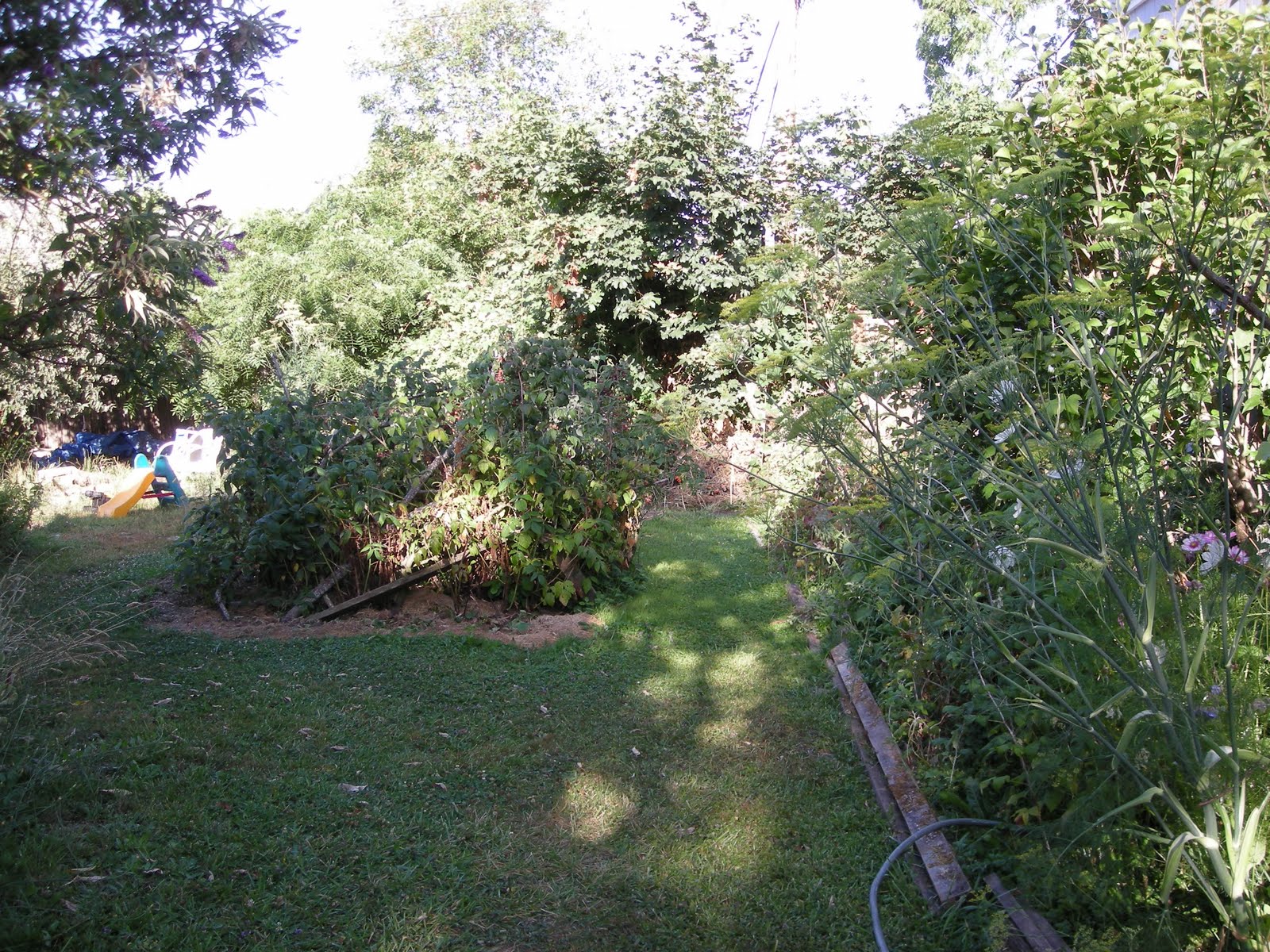
I'm living in the same place I've owned for 20-some years, a house I remodeled from under the ground up, next to a house my ex- remodeled that I now use for my shop. Someday I will probably remodel it again and rent it out, which is my actual retirement plan, since the Jell-O Art Museum might not pay the bills. My house payment is very low, and although my place is small, it has expanded a bit beyond its borders.
On the south side there used to be kind of an unpaved 7-foot wide alley, an easement for EWEB, but over the years the renters on that side have let the bushes and blackberries grow and it is effectively closed off and gardened over. Long ago the previous owners let me build beds on their side of the easement, where I now have artichokes and raspberrries. It's hard to imagine that cars used to drive through what is now a 3-foot path between gardens. As soon as I get some more stepping stones I will eliminate the grass there too. Plants grow so cooperatively.
Berries reclaim everything I don't weed; my backyard was total blackberries when I first moved in. They still survive across the back fence, and I don't mind, because of this:

We're about to get new neighbors in that house, renters with kids, and I hope they fix up the cob house, or at least take that tarp off the roof so I can look at its cuteness again. That cob house was built in a month the summer I was putting in my foundation over on my side, back before there was a fence. My son was five and he and his friend completely covered themselves with mud from the pit the cob was being made from. The crew making the curvy walls and setting in the windows was finished by midsummer. My project took 12 years...but my roof doesn't leak, either. Yet. My days of tarpage are over on this side...no, wait, I still have the plastic-covered piles of stuff needed to finish the various projects left over. That's probably a permanent state.
Everytime I get new neighbors on the south side I make sure to explain that I have gardened their yard for 20 years, and so far it hasn't been a problem. One landlord proposed a fence over there but luckily I convinced them not to build it. I need the open space, and it has forced good neighbor behavior for us to share the berries and the other backyard joys. Little kids live there now and I really love seeing them naked in the strawberry patch or toddling past a raspberry vine and latching onto a ripe one that tears off just in time, and gets smeared around a little mouth. I have no problem at all adjusting to picking only the higher ones for myself and thinking about the concept of "easy pickings" as I rummage through the strawberry leav
 es farthest from the stepping stones for the elusive ripe ones. I even shared my blackcap raspberries without a lot of grumbling. It has given me a teeny taste of grandchildren since I am still working on the empty nest feelings left behind by my 20-year-old. There are actually plenty of kids to go around if I get lonely for some. I live right near Seven Stars Childcare and I can always go down there to be delighted and amazed, and regularly do. I get some of my greatest ideas from Deb, Chris, and the kids.
My most troublesome neighbor this week is the Lane County Fair. When the people up the street had their garage sales, I got a wonderful chair and a cool pedestal thing that is perfect for Jell-O, but the County Fair brings me trash and picked flowers and pears and people staring at me when I am out in the yard or by an open window or door. Fairgoers seem oblivious to the fact that people live here. They park in front of our driveways, they make a ton of noise, and they tromp on our gardens. They are here and gone in five days though (not counting the ones who camp at the Fairgrounds for two weeks) and I do get the wonderful benefit of hearing cows in the morning. I can only water in the morning and the windows have to stay closed in the evenings because of the motorcycle stunts and metal bands. I do get free tickets if I want to see the quilts and old cars and I do usually go. It's a mixed bag. I get a lot of benefits from the open space at the Fairgrounds most of the year, a good place to skate and teach teenagers to drive, and just watch clouds come in from the west. One of my favorite bittersweet memories is right after 9-11 when no planes were flying, and lots of people were wandering the fields behind the Fairgrounds, looking for solace. The sky was wide and blue, with no contrails, and a huge thunderstorm brewed up bringing everyone out of their houses to re-evaluate life itself. There was agreement that it is precious.
I'm a farmer at heart, from Nebraska homesteader stock on my Mom's side. I have always been a plant worshipper from my earliest childhood. I'm a birder too, a naturalist I guess. Anyway, the natural world holds me together. I'm not averse to modifying it for my needs, though I crave to be where nature is not modified by man at all. Hard to get there, particularly without a car.
I'm suffering from loss this week, I realized. Not only from the empty nest and the human deaths I've recently been touched by (Farewell, Christy Parker, original Radar and amazing grace), but by the approach of autumn (more death), by the near-death-sentence of my old car (a money infusion may give it a few more years), and in general by the fears of change that crop up periodically.
I counseled myself that the only inevitability is change itself. There will always be loss. It is a struggle but grace always follows when we relax and surrender our resistance. I've hit some lows in the past few weeks but found comfort and have always been able to return to my natural state of joy and curiousity for the next thing. I feel strong and resilient, and am pretty sure there will be summer again, with luck, and anyway, there's a bit more of this one yet. There might even be ripe tomatoes, and the grapes are looking good. Recent upheavals in one area of my life are balanced by big-hearted events across the street (I am being photographed for the Beautiful Booth of the Month tomorrow, so excited) and it all marches on in its messy, complicated way. I'm still marching.

Heading out to pick a quart of raspberries for my lunch tomorrow, finishing up a pile of stuff for my friend to give away at Burning Man, savoring the opportunities and love that I do have. Sun's out, Jell-O is sparkling, and Gabriel and the Second Line are ready for that long walk to the cemetary and that short dance back to the hall where the potluck awaits. Eat, everyone! Get a piece of that pie before it's all just crumbs on the table.
Sunday, August 8, 2010
And you thought it was only for April Fools

Some incredible Jell-O Art showed up on my front porch the other day, courtesy of prominent Jell-O artist Celeste LeBlanc. She donated it to my Jell-O Art Museum, which is my plan for when I am a tiny little old lady. I will have a basket out for your dollar donation and will be glad to tell you what I remember of the many decades of Jell-O art here in Eugene.
I will make little cramped signs in spidery handwriting telling details of the recipes and techniques used to make the pieces, which will vary in size from these lifesize torsos to tiny shrunken rosebuds. You'll get a lot for your dollar, if you are fascinated by dusty, slightly moldy pieces of old gelatin in faded jewel colors.
One of Celeste's great skills, besides her mastery of the Jell-O garment, is her ability to jettison, re-group, tear apart and re-assemble art and artifact. I am a saver, and getting rid of still-useable objects is not something I can easily do. I fill the corne
 rs of my two little houses with all manner of abandoned possessions and natural finds. My museum will be the natural outgrowth of my art-making. I could probably easily fill it with my own leftover pieces, all documented with as much detail as I can remember. Celeste has a great memory and between her and the other Angels, I have enough wild stories to fill many walls, but I will try to stick to the Jell-O side of the stories and leave the Angel stuff to some other venue.
Or perhaps I will have another room filled with the Radar Angel memorabilia I could collect. I could get those flying Angels from the airport mural. There would be no shortage of costume items, decorated cat-eye glasses and scarves, veils, ruffles and boas. Don't forget the aprons and vintage dresses, and the set of bras made from coconut shells, Jell-O molds, funnels and plastic bowls. I could have a little lending service for costumes and accessories, because I know many women who have more than enough of these, yet will still want them a few times a year for the Jell-O Show, Country Fair, and Slug Queen compe
 titions. Men too. I'd need a whole closet for those ugly polyester shirts and shiny pants, and the puffy-sleeved tunics and tights. Shoes would line the walls.
It's silly, but it's a plan for the future that makes me smile, and well balances the grimmer plans for dump runs and yard sales and piles of medical equipment that will come with the indignities of "retirement" to use a euphemism for the phase of life no one wants to discuss much. I like having a wacky plan a lot.
And speaking of wacky plans, today on the Park Blocks, Celeste and her partner Eric Daws are among the other prominent and not so well-known re-use artists at the Re-use Art Fair run by Next Step. Go see how she deals with her propensities to collect and destroy. Be inspired as I am.
And on Friday, in the same location, the annual Slug Queen Coronation takes place, starting at 6:30. No two alike! Guaranteed guffaws. Several Radar Angels are among the Old Queens, old courts, and lame jokes. It's the perfect drop-in for a summer evening and you will be amazed by something, no question. Go ahead, dress up.
 You know you want to.
And if you find any Jell-O in your closet, I don't charge to take donations for the museum.
Friday, August 6, 2010
A Life Well Made
Maybe death has been on my mind because it is in my life, in all of our lives, even though we pretend hard that it is not. Our Market lost two people in the last two days, Carole Bauman, and Michael Caffrey.
With such a large family, this is not so unusual, but each loss has its unique impact and each person is so special to their neighbors, our history, and our family. I had the great honor of visiting Michael in his home yesterday, just hours before his body stopped working. He tried so hard to speak to us and we are sure he was listening as closely as he could to our voices even though he was already far down his trail.
He posted a small handwritten note on his door telling his friends where he wanted his ashes to be scattered, near Paisley in the woods and rocks he loved. I will always picture him as a rockhound; I know he spent countless hours hiking, photographing, and picking up rocks out there. His old truck is parked now but I hope his spirit is free to roam.
I didn't know he had such a beautiful body of work, stacks of evocative paintings and the exquisitely jewel-like mobiles he made with his hand tools on his handmade workbench. He wasn't finished with his work. I got the sense that he and I were much the same, that our work was our focus and joy and what we spent most of our time on earth pursuing. I can't speak for him, and we weren't that close, but it was obvious from his art that it expressed his essence and he shared a lot of it for a very long time. He was 74.
In my new space at the Holiday Market, we were next door neighbors for the first time last season. I had been thinking of ways to help him this year, to try to make it easier and to allow him one last time to really be seen among the things he had created. He won't be there now, but I will help, if I can, to see that his work is viewed and treasured and that his life is celebrated with the dignity and privacy he deserves.
Craftspeople are such a fascinating group of similar individuals, working alone for the most part, keeping the passion under control and expressing it slowly over a lifetime. Most of us don't shout about ourselves, we just keep our hands busy and our minds on the task of doing the work the way we think it should be done. Michael was a serious and exacting craftsman, and his simple and elegant work was always out of my price range, but now of course, it seems priceless. His sister told me that a few days ago they hung all his mobiles on the wire he used to make them, and it was easy to picture him crafting them, getting that balance, pushing it to it's fulcrum and past it a little, planning the flow and beauty and making and hanging all the finely crafted pieces, way up near the ceiling, since he was so tall. She said he made her take off all the price tags.
It was good to know you, Michael. I'm looking forward to hearing more stories of your life and hope I never forget the images that burned into my mind yesterday, bright spots of color on black backgrounds, ghostly white portraits, sketches of ravens and crows, handmade arrows and napped points. I'm so touched that we connected.
Take care of yourselves, all you living people. Be kind to each other, pay attention, and notice things. There will come the day when we won't be here, and our work will lie unfinished. May we feel the grace of the moments.
With such a large family, this is not so unusual, but each loss has its unique impact and each person is so special to their neighbors, our history, and our family. I had the great honor of visiting Michael in his home yesterday, just hours before his body stopped working. He tried so hard to speak to us and we are sure he was listening as closely as he could to our voices even though he was already far down his trail.
He posted a small handwritten note on his door telling his friends where he wanted his ashes to be scattered, near Paisley in the woods and rocks he loved. I will always picture him as a rockhound; I know he spent countless hours hiking, photographing, and picking up rocks out there. His old truck is parked now but I hope his spirit is free to roam.
I didn't know he had such a beautiful body of work, stacks of evocative paintings and the exquisitely jewel-like mobiles he made with his hand tools on his handmade workbench. He wasn't finished with his work. I got the sense that he and I were much the same, that our work was our focus and joy and what we spent most of our time on earth pursuing. I can't speak for him, and we weren't that close, but it was obvious from his art that it expressed his essence and he shared a lot of it for a very long time. He was 74.
In my new space at the Holiday Market, we were next door neighbors for the first time last season. I had been thinking of ways to help him this year, to try to make it easier and to allow him one last time to really be seen among the things he had created. He won't be there now, but I will help, if I can, to see that his work is viewed and treasured and that his life is celebrated with the dignity and privacy he deserves.
Craftspeople are such a fascinating group of similar individuals, working alone for the most part, keeping the passion under control and expressing it slowly over a lifetime. Most of us don't shout about ourselves, we just keep our hands busy and our minds on the task of doing the work the way we think it should be done. Michael was a serious and exacting craftsman, and his simple and elegant work was always out of my price range, but now of course, it seems priceless. His sister told me that a few days ago they hung all his mobiles on the wire he used to make them, and it was easy to picture him crafting them, getting that balance, pushing it to it's fulcrum and past it a little, planning the flow and beauty and making and hanging all the finely crafted pieces, way up near the ceiling, since he was so tall. She said he made her take off all the price tags.
It was good to know you, Michael. I'm looking forward to hearing more stories of your life and hope I never forget the images that burned into my mind yesterday, bright spots of color on black backgrounds, ghostly white portraits, sketches of ravens and crows, handmade arrows and napped points. I'm so touched that we connected.
Take care of yourselves, all you living people. Be kind to each other, pay attention, and notice things. There will come the day when we won't be here, and our work will lie unfinished. May we feel the grace of the moments.
Friday, July 30, 2010
Four Questions

I saw a man last week at the market wearing a couple of my OCF-related products, a shirt that said "Yes, yes, yes" and a hat that said..."YES". I showed him my delight and he said "I have four questions for you." I'm sure he had perfected that line and was happy to get the chance to use it.
So, Kim wrote in the newsletter that she was looking for candidates for the Beautiful Booth of the Month award, and I volunteered. In all my years of market I have never been accused of having a beautiful booth, mostly due to my propensity for the people-pleasing variety of diverse offerings that pretty much translate as too much clutter. I have always enjoyed a lot of visual stimulus. I like to look at the things I like.
I have been noticing though, that since you only get a few moments of the typical customer's attention, having too wide of an array seems to confuse and overwhelm, so I have been trying different things to simplify. I went to look at the files for Beautiful Booth, and realized she actually does a full profile writeup which is maybe a little intimidating, but with the recent success of my Eugene Weekly appearance, I think maybe I am ready for that.
My booth is not ready, though. I took the opportunity to view it through the photographer's eye, and asked Kim to give me some tips for improvement before she chooses me or decides not to.
It was illuminating. I also viewed the gallery of all of the Holiday Market booths from last year, trying to see what appealed to me in display options, and what didn't work even for a lover of visual clutter. Gradually I have tried to shift things in the direction of simplicity.
I changed my backdrop to a light purple from the turquoise that made it too dark. I have far too many things on the ground, like my bags and my own personal stuff, that all need to go behind a barrier or be hung up. I've been using a really cool grid thing I got from Circle of Hands and I got a brilliant idea for placing it differently that I will try this week, to see if that can solve at least that one problem.
Raven and I put our bikes and carts behind our booths in a really efficient but not so attractive way, and I need to use a bigger backdrop to hide them better. Not having a booth structure is a challenge but now that I have the two umbrellas to move around for shade, I like working without the booth. Of course when it starts to rain again I will have to rethink the whole thing, but for tomorrow I have some new ideas.
Kim says she photoshops things out but customers can't do that. Trying to look professional is worth the effort, and working for the last year or so on beautifying has been gratifying. My sales have increased, and I feel better. No decline or contraction in that aspect of my aging life.
Another of my goals is to actually be set up by 10:00, and I'm getting closer. I always thought leaving things on the hangers was lazy and took up too much space, but I have discovered that it works really well if you have enough plastic tubs. I never wanted to accumulate plastic tubs but now I swear by them. I have also become enamored of zipties. So a little backsliding on the environmental front, but I've heard they have made some reuseable zipties so I will look for them. The tubs stack up well too and although I vow I will not use them as tables, they are good for hiding extra stock and other things that don't need to be displayed but are handy to have on site during the day, like extra grid hangers and such.
My records for last year showed that August was the biggest summer month for me on the Park Blocks, and Tuesday was good this week, so I am all retail, retail, retail. It's fun. The gardens are almost under control, writing could happen soon, and I am again in love with summer. I even put up a hammock and have gotten in it a few times. Still have boxes of stuff to sort from the Fair, but jettisoned a few for my son's garage sale, and the silk studio is almost useable again. No tulips or clematis left to finish those scarves, but there are innumerable other subjects to paint.
Beauty all around. All of the questions have one simple answer.
Thursday, July 15, 2010
The Dusty Piles

This week is filled with the slog through the piles of stuff brought home from the Mall of the Woods (and I call it that with the utmost of affections). It actually takes several weeks since I have to sort everything in my shop and put many things away for a year, while getting back into production and catching up with all the tasks that were deferred. Still, the pressure is off and I get to enjoy the heat of summer as I work.
I have to wash the rugs and sarongs and sheets and various decorative items and put them where I will be able to find them for Holiday Market or next year's fair. I try to make notes about what worked and didn't as it is a constant practice of refinement. It worked really well this year! I tried all kinds of new displays and arrangements and almost sold out of hats, once I got the display duct-taped to the post so it would stop deferring to gravity.
Of course like most people I love the pre-Fair days the most, in the quiet and soft woods with all the creatures still in place. It's wonderful to have a home where pretty much everyone I know walks by my front porch at least once, whether or not they stop to talk. Parades twice a day, the ever-amusing sweep in the late evening, so many appreciative customers and the magical dropping in of new ideas and directions all make for a fleeting wonder that really does somehow result in psychospiritual rejuvenation.
My project of the Drenched Wench didn't work, so I jettisoned it on Sunday before Fair and might not ever do it now. I was happy that I didn't print the big pile of lovely shirts I had for it, since my pattern is usually to just power through my assigned tasks without hesitation. I'm finally learning that I want to put the extra effort into things that really make me proud of myself and not just throw stuff out there. I put my Radar Angels glasses on for abou
 t 5 minutes and didn't even take any costumes to speak of, and just hunkered down and worked as hard as I could for the duration. It was worth it.
I didn't really have time for a good sauna though, so had to clean mine out and take one on Wednesday night. It was great, but being naked in the dark with a varied group of people all getting clean and rested is a big treat and next year I have to make it a higher priority. No one throws a naked party like the Ritz. I know the myth is that nights at the Fair are the best, but I went to bed at dark on Saturday night and don't regret it. I did enjoy walking the paths in my pajamas and no flashlight, drifting along in the stream of excited young people who feel free and supported, going from jazz to bluegrass to old standards from several decades, just being grateful for all the life.
For some reason death is ever-present for me there, and I always set up a little altar for our departed friends, and make a lot of jokes. I made up a little song on Monday morning about Facebooking me when I am dead, and taking my stuff to the dump. I guess it softens the re-entry into town reality which is so much
 more harsh. Plenty of death in the newspaper, without as much of the joy we almost get used to out there. It can be over the top. At one point I just went to the spirit tower and cried it out. I have to do something to make sure the spirit tower stays, since I swear I will hang out there after-you-know-when.
So as the afterglow fades, I will post this one great story. A baby bird fell out of a tree right in the path in front of my booth! I think it was Wednesday. Some kids found it and it was put on a pillow and the Wildlife Team called. We had a wonderful time speculating on the type of bird (Flycatcher, or maybe Warbling Vireo), looking for the nest, and listening for the parents. Since we couldn't find the nest, we put it in a box and it went to the quiet of the rehab center to be fed and cared for until post-Fair, when it will be brought back home. I love how thoughtful the Fair has learned to be about such things, even when the thoughtfulness becomes almost unimaginably complicated. So many elegant solutions.
I heard a lot of birds after that and am sure that most figured out a routine for the duration. It must be wild to try to weather that onslaught that swells without warning and then disappears. I hope it rains soon to return all the dust to the ground and feed the salmonberries and other fruit. We were ready for rain this year but luckily we just had heat, and lots of it. One thunderstorm per decade is enough out there.
So now back to town concerns and summer languishing. I plan to read and get after those weeds in the yard, and make some time for writing and coming up with new products. It's a big refresh and reboot and fling and shedding and making of a mark. I think it was my 25th year in my spot. I marked it with a little interview in the Weekly where I told secrets. I hope I don't get in trouble. I didn't tell all of my secrets though. Catch me in the sauna and ask, some summer night. I'm likely to tell, in the dark and the sweat. I have to tell them all before I go, so they can be properly Facebooked. Or taken to the dump.
Subscribe to:
Posts (Atom)